# How to Measure Influencer Marketing ROI in 2026: AI Tools and Attribution
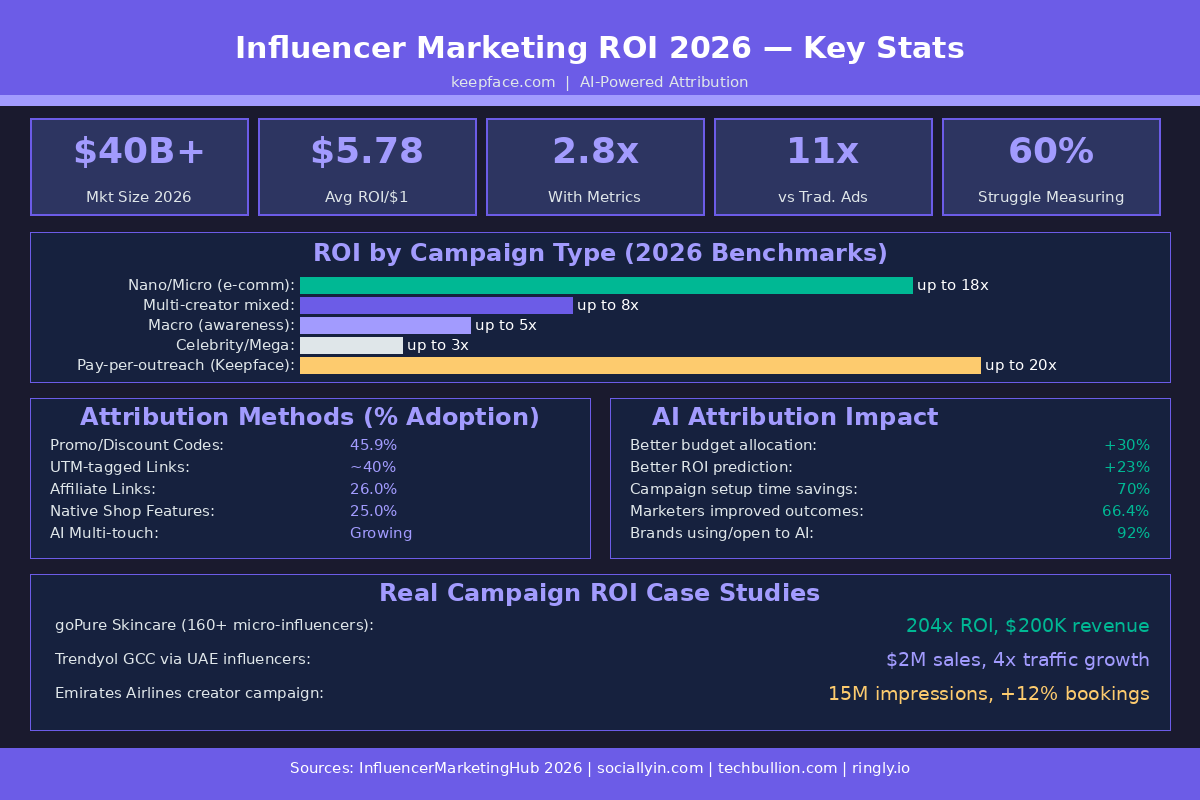
What is influencer marketing ROI? Influencer marketing ROI measures the return generated from creator campaigns relative to total investment — including outreach costs, content fees, and management overhead. Calculated as (Revenue Attributed to Campaign – Total Investment) / Total Investment x 100%, the industry average in 2026 is $5.78 returned per $1 spent, with top-performing campaigns achieving $18–$20 per dollar.
The influencer marketing industry hit $32.55 billion in 2025 and will surpass $40 billion in 2026. Despite this growth, 60% of brands still cannot prove their influencer campaigns are working. The problem is not whether influencer marketing delivers ROI — the evidence is overwhelming that it does. The problem is measurement.
Campaigns using proper measurement frameworks deliver 2.8x better ROI than those without. AI-powered attribution gives brands 30% better budget allocation accuracy. The brands that win influencer marketing in 2026 will be those that move from gut-feel reporting to data-driven attribution.
This guide covers the 8 metrics that actually prove influencer ROI, the AI attribution tools changing how campaigns are measured, and the step-by-step framework for building attribution into every campaign from the start.
Track influencer campaign ROI with built-in attribution on Keepface →
Table of Contents
- Why Measuring Influencer Marketing ROI Is Harder Than Ever
- The 8 Metrics That Actually Prove Influencer ROI
- AI-Powered Attribution: The 2026 Standard
- Influencer ROI Benchmarks: What to Expect in 2026
- Attribution Methods Ranked: Promo Codes to Multi-Touch AI
- Real Campaign Case Studies: ROI in Action
- The Keepface Approach: Built-In Attribution from Day One
- Key Takeaways
- FAQ
Why Measuring Influencer Marketing ROI Is Harder Than Ever in 2026
Quick answer: Influencer ROI measurement is complex because customer journeys span multiple touchpoints, ephemeral content disappears before it can be tracked, and most brands still use last-click attribution models that under-count creator impact by as much as 70%.
Three structural problems make influencer ROI notoriously difficult to measure:
1. Multi-touchpoint customer journeys. A consumer might discover your brand through an Instagram post, research on Google, re-engage through a TikTok video, and convert via a search ad. Last-click attribution credits only the search ad — making the influencer appear to have delivered zero ROI despite initiating the journey.
2. Ephemeral content. Instagram Stories, TikTok videos, and YouTube Shorts can disappear or lose algorithmic traction within 24–72 hours of posting. Tracking must happen in real time. Traditional reporting cycles miss this entirely.
3. Fragmented platforms. Each social platform has its own analytics format, data export limitations, and API restrictions. Manually aggregating data from Instagram, TikTok, YouTube, and e-commerce platforms into a single ROI view is a full-time analytics job.
The result: 26–60% of marketers cite ROI measurement as their primary obstacle to scaling influencer marketing, even as 80% plan to maintain or increase investment in 2026.
The 8 Metrics That Actually Prove Influencer ROI
Quick answer: Move beyond reach and impressions. The metrics that actually prove ROI are engagement rate, cost-per-engagement, attributed conversions, revenue attribution, cost-per-acquisition, share of voice, brand lift, and creator response rate.
In 2026, boards and leadership teams are asking harder questions about campaigns: not how many people saw the post, but how many leads it generated and what revenue can be attributed. Here are the 8 metrics that answer those questions:
| # | Metric | What It Measures | How to Calculate |
|---|---|---|---|
| 1 | Engagement Rate | Content quality + audience resonance | (Likes + Comments + Shares) / Impressions × 100 |
| 2 | Cost-Per-Engagement (CPE) | Efficiency of spend vs interaction | Total Campaign Cost / Total Engagements |
| 3 | Attributed Conversions | Direct actions driven by creators | UTM link clicks → goal completions in GA4 |
| 4 | Revenue Attribution | Sales directly traceable to campaign | Unique promo code redemptions × order value |
| 5 | Cost-Per-Acquisition (CPA) | Efficiency vs actual customers acquired | Total Campaign Cost / Number of New Customers |
| 6 | Share of Voice (SOV) | Brand mentions vs competitors post-campaign | Brand Mentions / Total Market Mentions × 100 |
| 7 | Brand Lift | Change in brand awareness + purchase intent | Pre/post survey: awareness, consideration, intent |
| 8 | Creator Response Rate | Campaign viability before any budget is spent | Responses / Total Outreach × 100 |
Of these eight, revenue attribution and cost-per-acquisition are the metrics most directly connected to business outcomes. A campaign that delivered 500,000 impressions but zero tracked conversions is a difficult sell to a CFO. A campaign that delivered 1,200 promo code redemptions at a $12 CPA — against a $48 LTV — is self-evidently profitable.
The good news: 74% of brands now actively track sales from influencer campaigns, up from less than 50% in 2023. The measurement gap is closing.

AI-Powered Attribution: The 2026 Standard
Quick answer: AI attribution analyzes thousands of customer journeys simultaneously to assign proportional credit to each influencer touchpoint, delivering 23% better ROI prediction accuracy than last-click models.
Traditional attribution models — last-click, first-click, linear — were designed for paid media, not creator-driven campaigns. They systematically undercount influencer impact because they cannot model the extended awareness and trust-building that happens across multiple organic touchpoints over days or weeks.
AI-powered attribution addresses this with three key capabilities:
Multi-touch journey modeling. Machine learning algorithms analyze actual customer journey data — every touchpoint from first influencer exposure to final conversion — and assign proportional credit based on what the data shows actually drives decisions. Brands using this approach see 23% better ROI prediction accuracy versus rule-based models.
Automated content tracking. AI tools monitor campaign content across platforms in real time, capturing performance data before it disappears. For ephemeral content (Stories, Reels), this automated tracking is the only viable measurement approach. AI cuts campaign tracking setup time by up to 70% compared to manual methods.
Fraud detection. AI identifies fake followers, engagement pods, and bot activity at scale — preventing brands from attributing ROI to artificial interactions. This is increasingly critical as the influencer market grows: 66.4% of marketers report improved campaign outcomes after implementing AI tools, partly because AI removes inflated metrics from ROI calculations.
AI Attribution Adoption by Brand Size (2026)
Enterprise
92% using AI
Mid-Market
66.4% improved
SMB
56% tracking ROI
Source: Influencer Marketing Hub Benchmark Report 2026; sociallyin.com influencer marketing statistics 2026
For brands without dedicated analytics infrastructure, AI-powered influencer platforms provide the same attribution capability as enterprise tools — without the six-figure software investment. Platforms like Keepface have built-in attribution because outreach tracking, response rates, and UTM parameter management are part of the core campaign workflow.
Influencer ROI Benchmarks: What to Expect in 2026
Quick answer: Average influencer marketing ROI in 2026 is $5.78 per $1 spent. Micro-influencer campaigns typically deliver 3x–8x ROI. Top campaigns using performance-based attribution and nano/micro creator mixes have achieved $18–$20 per dollar.
Setting realistic ROI expectations before a campaign launches is essential for measurement. Here are the 2026 benchmarks across key dimensions:
| Campaign Type | Typical ROI Range | Primary Attribution Method |
|---|---|---|
| Nano/micro influencer (e-commerce) | 5x – 18x | Unique promo codes + UTM links |
| Macro influencer (brand awareness) | 2x – 5x | Brand lift surveys + share of voice |
| Multi-creator campaign (mixed tiers) | 3x – 8x | AI multi-touch attribution |
| Celebrity/mega influencer | 1.5x – 3x | Reach + impressions (awareness KPIs) |
| Pay-per-outreach (Keepface model) | 8x – 20x+ | Response rate + attributed conversions |
The pay-per-outreach model significantly changes the ROI calculus because it eliminates the largest cost component of traditional campaigns: agency fees and guaranteed post minimums. When outreach costs $0.75 per creator rather than $5,000 in retainer fees, even a modest conversion rate delivers exceptional ROI.
Industry-wide: influencer marketing delivers approximately 11x the ROI of traditional digital advertising on an equivalent-spend basis. This is the headline statistic driving the 80% of brands maintaining or increasing influencer investment in 2026.

Attribution Methods Ranked: Promo Codes to Multi-Touch AI
Quick answer: Unique promo codes and UTM-tagged links are the most widely used and easiest to implement. AI multi-touch attribution provides the most accurate picture but requires more infrastructure. For most brands in 2026, UTM links plus unique promo codes is the right starting point.
There are five main attribution methods, each with different implementation complexity and measurement accuracy:
- Unique promo codes (45.9% adoption) — The most straightforward method. Each creator receives a unique discount code (CREATOR10, etc.). Sales using that code are directly attributed. Limitations: codes can be shared beyond the creator’s audience; works mainly for e-commerce.
- UTM-tagged landing page links (40%+ adoption) — Every link in creator content includes UTM parameters (utm_source, utm_medium, utm_campaign, utm_content). Google Analytics 4 captures the full journey from creator touchpoint to conversion. Works across all business types; requires proper GA4 setup.
- Affiliate links (26% adoption) — Creators earn commission on attributed sales via unique tracked links. Aligns creator incentives with brand performance goals. Works best for high-volume e-commerce with established affiliate programs.
- Platform-native shop features (25% adoption) — Instagram Shopping, TikTok Shop, and YouTube Shopping allow direct attribution of in-platform purchases to specific creator content. Highly accurate for products available through these channels.
- AI multi-touch attribution (emerging standard) — Machine learning models analyze entire customer journeys across all touchpoints — influencer content, paid ads, organic search, email — and assign proportional credit to each. Delivers 23% better ROI prediction than rule-based models. Requires integration between influencer platform, ad platform, and CRM/e-commerce data.
For most brands running their first structured influencer attribution programme in 2026, the recommended starting point is: UTM links for every creator + unique promo codes for e-commerce. This combination covers 80% of trackable conversions with minimal technical complexity.
Real Campaign Case Studies: ROI in Action
Quick answer: Real campaign data shows ROI ranging from 5x to 204x — with the highest returns consistently coming from micro and nano-influencer campaigns with direct attribution methods.
These three case studies demonstrate what proper influencer ROI measurement looks like in practice:
Case Study 1: goPure Skincare — 204x ROI
- Creators: 160+ micro-influencers
- Campaign type: Product review + affiliate link
- Attribution method: Unique affiliate links + UTM tracking
- Conversion rate: 26%
- Revenue generated: $200,000 from 1,705 orders
- ROI: 204x on influencer fees
- Key insight: Micro-influencer scale (160 creators) combined with performance-based affiliate links creates a self-selecting quality filter — only creators confident in conversion accept affiliate terms.
Case Study 2: Trendyol GCC Launch — 4x Traffic Growth
- Creators: UAE-based influencers (mixed tiers)
- Campaign type: Brand launch awareness + conversion
- Attribution method: UTM landing pages + brand lift survey
- Revenue generated: $2,000,000 in attributed sales
- Traffic impact: 4x growth on launch traffic
- Key insight: UAE influencers reach Gulf-wide audiences, multiplying single-market spend into multi-market impact. Attribution captured both direct sales and the indirect brand lift that drove organic search volume.
Case Study 3: Emirates Airlines — 15M Impressions, 12% Booking Uplift
- Creators: Travel macro-influencers
- Campaign type: Awareness + booking conversion
- Attribution method: Custom campaign URLs + booking UTM tracking
- Impressions: 15,000,000
- Booking uplift: 12% on targeted routes
- Key insight: For high-consideration purchases like flights, the attribution window must extend 30+ days beyond initial exposure. Last-click attribution on a 7-day window would have shown near-zero ROI for a campaign that actually drove 12% incremental bookings.
The common thread: all three campaigns used direct tracking methods (affiliate codes, UTM links, booking-specific URLs) rather than relying on reach or impressions as the primary success metric.
Build attribution into your campaign from day one with Keepface →
The Keepface Approach: Built-In Attribution from Day One
Quick answer: Keepface’s pay-per-outreach model provides inherent attribution at the outreach stage — you see exactly which creators responded, at what rate, and can track content directly to conversion using UTM parameters built into every campaign brief.
Most influencer marketing platforms add attribution as an afterthought. Keepface’s model makes attribution structural because the pay-per-outreach model requires tracking at every stage:
Stage 1: Outreach attribution — You know exactly which creators were contacted, when, and via which channel (Email/WhatsApp/Telegram). Response rates are tracked in real time, giving you creator-level data before any content is produced.
Stage 2: Response rate ROI — With 2,000,000+ verified creators across Keepface’s platform and historical response rate data per list, brands can calculate expected responses before spending a dollar on content fees. This makes ROI forecasting possible at campaign planning stage.
Stage 3: Campaign brief with UTM integration — Keepface campaign briefs include standardised UTM parameter structures, ensuring every piece of creator content is tagged for attribution from the moment the brief is delivered. No retrofitting UTM links after the fact.
Stage 4: AI-powered creator matching — Keepface’s AI matching system prioritises creators with the highest historical response rates within a given category, improving both outreach efficiency and attribution accuracy (fewer non-responders means less noise in the attribution data).
The result: 6,000+ brands trust Keepface for influencer campaigns precisely because the cost structure makes ROI measurement straightforward. When outreach costs $0.75 per creator instead of $5,000 in agency fees, the ROI threshold is dramatically lower — and easier to demonstrate.
Key Takeaways
- 60% of brands still struggle to measure influencer ROI — but those using proper measurement frameworks see 2.8x better returns
- Average influencer marketing ROI in 2026: $5.78 per $1 spent; top campaigns hit $18–$20 per dollar
- AI attribution delivers 23% better ROI prediction accuracy than rule-based last-click models
- The 2 most accessible attribution methods: UTM-tagged links (for all campaign types) + unique promo codes (for e-commerce)
- Nano and micro-influencer campaigns consistently deliver the highest ROI (5x–18x), while mega-influencers deliver awareness metrics
- 74% of brands now track sales from influencer campaigns — measurement sophistication is becoming a competitive differentiator
- AI tools cut campaign setup and tracking time by up to 70% and enable real-time capture of ephemeral content performance
- Keepface’s pay-per-outreach model builds attribution into the campaign structure from day one — with response rates tracked before any content budget is committed
FAQ
What is influencer marketing ROI and how do you calculate it?
Influencer marketing ROI measures the return generated from creator campaigns relative to total investment. The formula is: (Revenue Attributed to Campaign – Total Investment) / Total Investment x 100%. Total investment includes outreach costs, content fees, management overhead, and any gifted product. Revenue attribution requires tracking methods — UTM links, unique promo codes, or affiliate links — to connect sales to specific creator content. In 2026, the industry average is $5.78 returned per $1 spent, but this varies significantly by creator tier, category, and attribution method. Micro-influencer campaigns with direct attribution regularly achieve 5x–18x ROI; mega-influencer campaigns optimised for awareness typically deliver 1.5x–3x.
Is influencer marketing ROI better than traditional digital advertising in 2026?
Yes — influencer marketing delivers approximately 11x the ROI of traditional digital advertising on an equivalent-spend basis, according to 2026 benchmark data from Influencer Marketing Hub. The gap has widened as paid social CPMs have increased significantly while creator content continues to benefit from organic reach multipliers. The caveat is that the comparison depends heavily on attribution method: brands measuring influencer ROI via last-click only will systematically undercount influencer impact relative to paid ads, which have more mature attribution infrastructure. A fair comparison requires multi-touch attribution that captures the full customer journey.
How do I calculate influencer marketing ROI without a dedicated analytics team?
Start with the two most accessible methods: UTM-tagged links in every creator brief, and unique promo codes for e-commerce campaigns. UTM links require a Google Analytics 4 account (free) with goals set up for your conversion actions. Promo code tracking is built into most e-commerce platforms (Shopify, WooCommerce, Magento). Together, these two methods capture the majority of trackable influencer conversions with no additional software cost. For response rate tracking — which predicts ROI before content is even created — platforms like Keepface provide real-time outreach and response rate data as part of the core campaign workflow.
How much ROI should I expect from influencer marketing in 2026?
Benchmarks for 2026: nano and micro-influencer e-commerce campaigns: 5x–18x; macro-influencer awareness campaigns: 2x–5x; multi-creator mixed-tier campaigns: 3x–8x; pay-per-outreach campaigns (Keepface model): 8x–20x+. These ranges assume proper attribution is in place. Campaigns without attribution tracking frequently report $0 ROI — not because they generated zero returns, but because the returns were not captured. The single highest-impact action a brand can take to improve reported influencer ROI in 2026 is implementing UTM tracking on all creator content.
What AI tools are best for influencer marketing ROI measurement in 2026?
The leading AI-powered influencer measurement tools in 2026 include platforms that integrate creator discovery, campaign management, and attribution in a single system. Key capabilities to look for: multi-touch attribution modeling, real-time content performance tracking, fraud detection (fake follower identification), and direct e-commerce platform integration (Shopify, WooCommerce). Brands using AI-powered attribution report 30% better budget allocation accuracy and 23% better ROI prediction compared to rule-based models. For SMBs and growing brands, Keepface provides built-in response rate tracking, UTM parameter management, and AI creator matching without requiring a separate analytics platform — keeping the attribution stack simple and integrated.
Conclusion
Influencer marketing ROI is not a mystery — it is a measurement problem. The $40 billion industry delivers an average of $5.78 per dollar spent, with top campaigns achieving $18–$20 per dollar. The brands that will outperform in 2026 are those that build attribution into every campaign from day one: UTM-tagged links, unique promo codes, response rate tracking, and AI-powered multi-touch models for the campaigns that warrant them.
The tools exist. The data exists. The gap between brands that can prove influencer ROI and those that cannot is not technology — it is process. Start with the two most accessible methods (UTM + promo codes), graduate to AI attribution as campaigns scale, and measure response rates as a leading indicator of ROI before any content budget is committed.
With 2,000,000+ verified creators, trusted by 6,000+ brands, and AI-powered matching that builds attribution into the outreach workflow, Keepface gives you the infrastructure to measure influencer ROI accurately from day one.
Launch and measure your next influencer campaign on Keepface →