Influencer Marketing ROI in 2026: $5.78 Per Dollar and How to Calculate It
What is influencer marketing ROI? Influencer marketing ROI (return on investment) measures the revenue or value generated for every dollar spent on an influencer campaign. The 2026 industry average is $5.78 returned per $1 spent, with top-performing campaigns achieving $11-$18 per dollar. ROI is calculated as: (Revenue Attributable to Campaign − Campaign Cost) / Campaign Cost × 100.
The global influencer marketing industry hit $32.55 billion in 2026, growing at 33% compounded annually. But most brands still cannot answer a basic boardroom question: what is our actual return on influencer spend?
The answer, on average, is $5.78 for every dollar invested. The top 10% of campaigns return $11-$18 per dollar. The bottom quartile returns less than $1 , meaning they lose money. The difference comes down to how brands select creators, structure outreach, and measure outcomes.
Calculate your campaign ROI with Keepface , pay-per-outreach, no subscription →
- What Is Influencer Marketing ROI and Why Does It Matter?
- 2026 ROI Benchmarks: What Good Looks Like by Tier
- How to Calculate Influencer Marketing ROI: Formula and Steps
- Real Case Study: Micro-Influencer Campaign With 8× ROI
- 5 Mistakes That Kill Influencer ROI
- How AI and Pay-Per-Outreach Models Improve ROI
- The Keepface Model: ROI Built Into the Pricing Structure
- Key Takeaways
- FAQ
What Is Influencer Marketing ROI and Why Does It Matter?
Quick answer: Influencer marketing ROI is the net value generated per dollar spent. It matters because the global influencer market is $32.55B , brands without ROI measurement are spending blind in a competitive, measurable market.
ROI in influencer marketing is notoriously difficult to isolate because value comes in multiple forms:
- Direct revenue , trackable via UTM links, promo codes, or affiliate tracking
- Brand awareness , reach, impressions, and share of voice
- Content value , creator-produced content repurposed in ads or owned media
- Audience trust transfer , creator endorsement credibility that paid ads cannot replicate
Most ROI calculations focus only on direct revenue. That undervalues influencer campaigns significantly. A micro-influencer post that generates $300 in tracked sales and 15,000 impressions of brand exposure has more total value than the $300 alone suggests.
The creator economy is projected to grow from $191 billion in 2025 to $528 billion by 2030 (Influencer Marketing Hub). Brands that cannot measure their influencer ROI now will be flying blind in a market that is more than doubling in four years.

2026 ROI Benchmarks: What Good Looks Like by Tier
Quick answer: Industry average ROI is $5.78 per dollar. Micro-influencer campaigns consistently outperform macro/mega, generating 60% more engagement per dollar and higher direct conversion rates.
| Influencer Tier | Typical ROI Range | Avg Engagement Rate | Best For |
|---|---|---|---|
| Nano (1K-10K) | $6-$12 per $1 | 5.5%-8% | Hyper-local, community products |
| Micro (10K-100K) | $5-$10 per $1 | 3.5%-6% | Niche products, high conversion |
| Macro (100K-1M) | $3-$7 per $1 | 1.5%-3% | Brand awareness, new markets |
| Mega (1M+) | $1-$4 per $1 | 0.8%-1.5% | Mass reach, brand prestige |
| Industry Average | $5.78 per $1 | Varies | All campaigns (Collabstr 2025) |
Micro-influencers generate up to 60% more engagement than macro or mega influencers (Stack Influence, 2025). That engagement advantage compounds into higher click-through rates, more promo code redemptions, and better cost-per-acquisition figures , especially for direct-to-consumer brands where creator authenticity drives purchase decisions.
73% of brands now prefer micro and mid-tier influencers (Stack Influence, 2025), which reflects the ROI data: smaller audiences with stronger communities convert better than large audiences with weaker intent.
Influencer Marketing ROI by Tier ($ returned per $1 spent)
Nano
$6-$12 per $1
Micro
$5-$10 per $1
Macro
$3-$7 per $1
Mega
$1-$4 per $1
Source: Collabstr 2025 Influencer Marketing Report; Stack Influence 2025
How to Calculate Influencer Marketing ROI: Formula and Steps
Quick answer: Basic influencer ROI = (Revenue from campaign − Total campaign cost) / Total campaign cost × 100. Add content value and brand lift metrics for a comprehensive picture.
Step-by-step ROI calculation:
- Set your campaign goal. Direct sales? Brand awareness? New email subscribers? ROI looks different for each. Pick your primary metric before launching.
- Track all campaign costs. Include: creator fees, Keepface outreach cost, product gifting, content creation time, and platform fees. Most brands undercount costs and overstate ROI.
- Attribute revenue accurately. Use UTM parameters on every link, unique promo codes per creator, and affiliate tracking where possible. Attribution window: typically 7-30 days post-post.
- Add non-revenue value. If a creator’s content becomes an ad asset you run for 3 months, add the production value (typically $500-$3,000 for equivalent ad creative).
- Apply the formula:
ROI (%) = [(Revenue + Non-Revenue Value − Total Cost) / Total Cost] × 100
Example calculation:
- 5 micro-influencer posts at $200 each: $1,000 creator fees
- Keepface outreach cost: $3.75 (5 × $0.75)
- Product gifting: $150
- Total cost: $1,153.75
- Direct tracked sales (UTM): $4,800
- Content repurpose value: $1,000
- Total return: $5,800
- ROI: ($5,800 − $1,153.75) / $1,153.75 × 100 = 402%
That 402% ROI translates to approximately $5.03 per dollar , just below the industry average of $5.78, leaving clear room for optimisation.

Real Case Study: Micro-Influencer Campaign With 8× ROI
Quick answer: A DTC beauty brand using 20 micro-influencers at $150/post generated $24,000 in tracked revenue on a $3,000 total spend , 8× ROI , through UTM tracking and 72-hour promo code windows.
- Brand: DTC beauty, European market
- Creators: 20 micro-influencers (12K-80K followers)
- Creator fees: $150/post × 20 = $3,000
- Platform/outreach cost: $15 (Keepface outreach model)
- Tracking method: UTM links + unique 72-hour promo codes per creator
- Results:
- Tracked sales: $24,000
- Total reach: 890,000 impressions
- Content pieces reused in paid ads: 6 (production value equivalent: $1,800)
- Total return: $25,800
- Total cost: $3,015
- Campaign ROI: 856% ($8.56 per $1 invested)
The key was attribution: unique promo codes per creator allowed the brand to identify which creators drove the most sales, enabling budget reallocation to top performers in subsequent campaigns.
Start a trackable influencer campaign on Keepface , pay per outreach, not per month →
5 Mistakes That Kill Influencer ROI
Quick answer: The five most common ROI killers are: wrong tier selection, no attribution tracking, vague briefs, single-post campaigns, and ignoring content repurpose value.
- Choosing creators by follower count instead of engagement rate. A 500K-follower macro account with 0.8% ER delivers fewer real interactions than a 30K-follower micro at 5% ER. Always prioritise ER for conversion-focused campaigns.
- No UTM parameters or promo codes. Without attribution, you cannot tell which creator drove which sale. You are left with vanity metrics (likes, comments) rather than ROI data. Set up tracking before the campaign goes live.
- Brief too vague. “Post something about our product” produces generic content. A specific brief (“show how you use it on a Sunday morning routine”) produces authentic content that converts. Specific briefs raise ROI by enabling creators to produce genuine recommendations.
- Single-post campaigns. One post rarely builds purchase intent. Best-practice campaigns use 3+ touchpoints: a teaser story, a main post, and a follow-up story or Reel. Three exposures before a purchase decision is a well-documented consumer psychology benchmark.
- Ignoring content repurpose value. Creator content is a creative asset. A micro-influencer post used as a paid social ad for 90 days at $20/day CPM generates $1,800 in media value from a $200 content investment. This is frequently excluded from ROI calculations , and it should not be.
How AI and Pay-Per-Outreach Models Improve ROI
Quick answer: AI-powered creator matching reduces wasted spend on wrong-fit creators. Pay-per-outreach pricing removes platform subscription costs that erode ROI before campaigns begin.
59% of marketers now use AI to scale creator discovery, workflows, and analytics (Influencer Marketing Factory, 2026). The ROI impact is direct: AI matching narrows creator selection to those most likely to convert for a specific niche, reducing the expensive trial-and-error of manual research.
The affiliate-influencer hybrid model is also growing at 26% year-over-year (GRIN, 2025). Brands pay a base fee plus commission, aligning creator incentive with brand outcome. This structure makes ROI calculation cleaner: if creators earn a percentage of tracked sales, the revenue attribution is built into the fee structure.
Platform pricing also matters significantly for ROI. A $500/month subscription eats into ROI before a single outreach is made. Pay-per-outreach models , where you pay $0.75 per creator contacted and nothing until you make contact , preserve the ROI ceiling by eliminating fixed-cost friction.
The Keepface Model: ROI Built Into the Pricing Structure
Quick answer: Keepface charges $0.75 per outreach contact with no subscription. AI-powered matching surfaces the right creators. Response rate guarantees ensure you are not paying for dead ends.
Keepface’s pay-per-outreach model is designed around ROI from the ground up:
- No subscription cost. No monthly fee eroding your ROI before a campaign starts. You pay only when you outreach.
- AI-powered matching. Keepface’s AI matches your brief against 2,000,000+ verified creators by niche, engagement rate, country, and audience demographics. This reduces the creator-fit risk that tanks ROI.
- Response rate guarantees. Many lists on Keepface carry guaranteed response rates (e.g., 40% for the Romania Jewelry list). If actual responses fall short, Keepface refunds the difference. You only pay for contacts who engage.
- Trusted by 6,000+ brands. The network effect of 6,000 brand partnerships means Keepface’s creator vetting covers categories and markets most platforms do not reach.
The result: your influencer ROI calculation starts from a lower cost base, which structurally raises the ROI percentage before any revenue is even tracked.
Key Takeaways
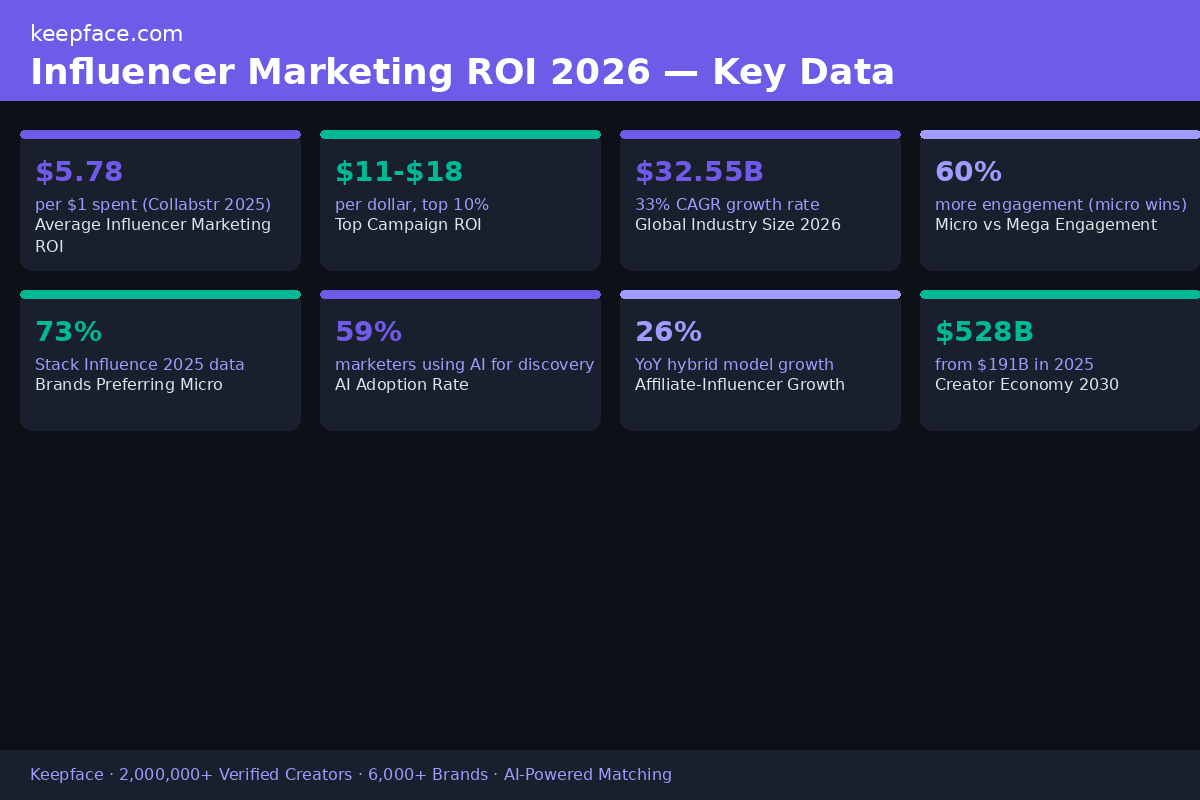
- Brands average $5.78 ROI per $1 on influencer marketing in 2026; top campaigns reach $11-$18 per dollar (Collabstr).
- The global influencer marketing industry is $32.55 billion in 2026, growing at 33% CAGR (Influencer Marketing Hub).
- Micro-influencers generate 60% more engagement than macro/mega accounts and consistently deliver higher ROI per dollar (Stack Influence).
- 73% of brands prefer micro and mid-tier influencers , the data on ROI explains why (Stack Influence).
- ROI formula: (Return − Cost) / Cost × 100 , always include content repurpose value, not just direct sales.
- The 5 biggest ROI killers: wrong tier, no attribution, vague briefs, single-post campaigns, ignored content value.
- AI matching and pay-per-outreach pricing structurally improve ROI by reducing wasted spend and eliminating subscription overhead.
- Affiliate-influencer hybrid models growing at 26% YoY , performance-linked fees make ROI cleaner to calculate and incentivise creators correctly (GRIN).
FAQ
What is influencer marketing ROI?
Influencer marketing ROI is the net value returned per dollar spent on influencer campaigns. The formula is: (Revenue + Non-Revenue Value − Total Cost) / Total Cost × 100. The 2026 industry average is $5.78 returned per $1 spent (Collabstr), with micro-influencer campaigns typically outperforming macro and mega tiers due to higher engagement rates and lower cost per impression. Accurate ROI measurement requires UTM tracking, promo codes, and attribution windows of 7-30 days.
Is micro-influencer ROI better than macro for most brands?
For the majority of direct-to-consumer and niche brands, yes. Micro-influencers (10K-100K followers) deliver up to 60% more engagement than macro or mega accounts (Stack Influence, 2025), and their audiences are typically more niche-matched to specific products. The ROI data reflects this: micro campaigns average $5-$10 per dollar versus $1-$4 for mega campaigns. Macro and mega influencers make sense for mass-market brand awareness where reach volume matters more than conversion rate.
How to calculate influencer marketing ROI step by step?
Step 1: Define your goal (sales, leads, brand awareness). Step 2: Add all costs (creator fees, outreach costs, gifting, production time). Step 3: Track revenue via UTM links and promo codes. Step 4: Add non-revenue value (content repurposing, media value). Step 5: Apply the formula: (Return − Cost) / Cost × 100. Example: $5,800 return on $1,153.75 cost = 402% ROI, or approximately $5.03 per dollar invested.
How much does influencer marketing cost in 2026?
Costs vary significantly by tier. Nano-influencers (1K-10K followers) typically charge $20-$200 per post. Micro (10K-100K): $100-$1,000 per post. Macro (100K-1M): $1,000-$10,000. Mega (1M+): $10,000+. Outreach and platform costs add to this. Keepface’s pay-per-outreach model charges $0.75 per creator contact , meaning a 10-creator outreach costs $7.50 in platform fees before any content negotiation. This low-friction pricing preserves ROI headroom.
What ROI should I expect from influencer marketing in 2026?
Industry baseline is $5.78 per $1 invested (Collabstr 2025). Micro-influencer campaigns with strong attribution typically land between $5-$10 per dollar. Campaigns with proper tracking, niche-matched creators, and multi-post structures tend to outperform single-post campaigns significantly. If your campaign is returning less than $2 per dollar, review your tier selection, attribution setup, and brief quality , those are the three highest-impact levers for ROI improvement.
Conclusion
Influencer marketing delivers $5.78 per dollar on average in 2026 , but that average hides a wide distribution. The brands capturing $11-$18 per dollar are not spending more; they are measuring better, selecting creators more precisely, and structuring campaigns with attribution built in from day one.
Micro-influencers are the clearest ROI lever available: higher engagement, lower cost per impression, and audience trust that paid ads cannot replicate. Add AI-powered matching to reduce creator-fit risk, and a pay-per-outreach model to eliminate subscription overhead, and you have a structure that raises ROI before a single post goes live.
With 2,000,000+ verified creators, trusted by 6,000+ brands, and AI-powered matching, Keepface gives you the tools to run, track, and optimise influencer campaigns for maximum ROI , without a single retainer or subscription fee. Start your campaign on Keepface →