How AI Is Transforming Influencer Marketing in 2026
What is AI influencer marketing? AI influencer marketing uses machine learning and data analysis to automate creator discovery, match brands with the highest-fit influencers, detect fraudulent accounts, and forecast campaign ROI before a dollar is spent. It replaces manual spreadsheet research with algorithm-driven precision across platforms and audience segments.
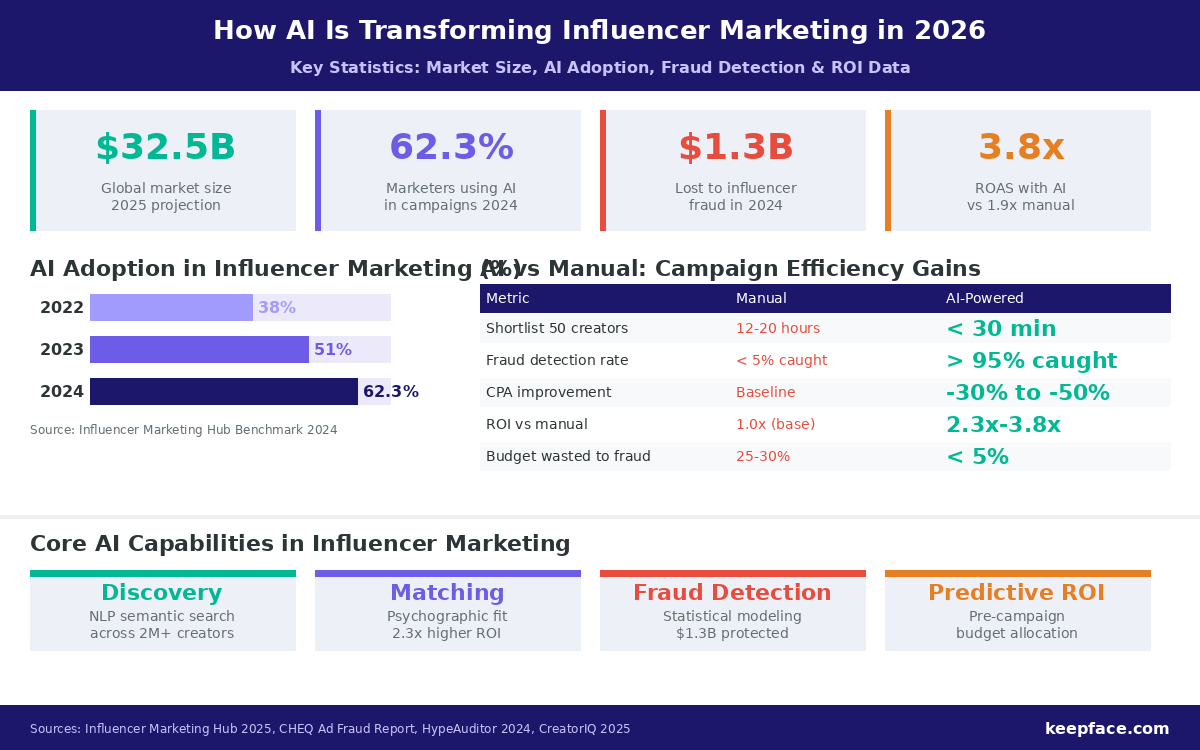
The global influencer marketing industry reached $24 billion in 2024 and is projected to surpass $32.5 billion by the end of 2025, according to Influencer Marketing Hub’s annual benchmark report. But size alone does not explain why brands are shifting strategy: an estimated $1.3 billion in influencer spend was lost to fraud in 2024 alone, and manual creator selection still takes marketing teams an average of 20 hours per campaign, according to Influencer Marketing Hub’s 2024 benchmark report. AI is closing both gaps, and the results are reshaping how campaigns are planned and executed.
Start your AI-matched influencer campaign on Keepface and reach 2,000,000+ verified creators today.
Table of Contents
- What Is AI Influencer Marketing?
- AI-Powered Influencer Discovery: Finding Creators at Scale
- How AI Matching Algorithms Work
- AI Fraud Detection: Protecting Your Budget
- Predictive ROI: How AI Forecasts Campaign Performance
- The Keepface AI Approach
- Key Takeaways
- FAQ
- Conclusion
What Is AI Influencer Marketing?
Quick answer: AI influencer marketing is the use of machine learning tools to automate and improve every stage of an influencer campaign, from finding creators and assessing their audience quality, to predicting how a campaign will perform and detecting fraudulent accounts before spend is wasted.
Influencer marketing has always been data-intensive in theory but gut-driven in practice. A brand manager would search hashtags, scroll profiles, build a shortlist in a spreadsheet, and email 200 creators hoping 20 replied. AI changes that pipeline at every stage.
The five core applications of AI in influencer marketing are:
- Creator discovery: Semantic search and natural language queries replace hashtag browsing. A marketer types “fitness creators in Germany with a tech-savvy female audience aged 25-35” and gets a ranked, scored list in seconds.
- Audience matching: AI analyzes demographic and psychographic signals in an influencer’s actual audience, not just follower count, to assess brand fit at the audience level rather than the profile level.
- Fraud detection: Machine learning identifies fake followers, purchased engagement, and bot activity that manual review consistently misses because the signals are statistical, not visual.
- Performance prediction: Predictive models trained on historical campaign data forecast expected reach, engagement, and conversion rates before campaign launch, allowing budget to follow probability rather than intuition.
- Content optimization: AI tools analyze top-performing content formats, posting times, and creative angles for specific creator-audience combinations, informing briefs before production begins.
By 2024, 62.3% of marketing professionals reported using AI tools in their influencer campaigns, up from 38% in 2022, according to Influencer Marketing Hub’s benchmark survey. The shift is no longer experimental: brands running full-stack AI campaigns consistently report 30% to 50% reductions in cost per acquisition compared to manually managed programs.
Global Influencer Marketing Market Size (USD Billion)
2022
$16.4B
2023
$21.1B
2024
$24.0B
2025
$32.5B
Source: Influencer Marketing Hub Benchmark Report 2025
AI-Powered Influencer Discovery: Finding Creators at Scale
Quick answer: AI discovery tools use natural language processing and audience similarity models to surface relevant creators in seconds instead of hours. They analyze content topics, audience demographics, posting behavior, and engagement quality across multiple platforms simultaneously, delivering shortlists that manual search cannot replicate at scale.
Manual influencer discovery has two persistent problems: it is slow, and it is surface-level. A researcher spending a full day on Instagram can evaluate perhaps 50 creators. A mid-tier AI discovery tool can evaluate 50,000 creators in that same time using signals the human eye cannot process: audience overlap with existing brand customers, semantic alignment between creator content and brand positioning, engagement velocity trends over 90 days, and cross-platform behavioral consistency.
AI discovery tools operate differently from simple search filters in four key ways:
- Semantic search: Instead of searching hashtags, a marketer describes the creator in natural language. “Parenting creator in Southeast Asia, female audience aged 28-40, posts about budget family activities” returns a filtered, ranked list drawn from millions of indexed profiles.
- Lookalike modeling: Upload your best-performing past creator and the algorithm identifies structurally similar accounts across platforms, including creators who have never worked with a brand in your category and therefore carry a lower saturation risk.
- Audience overlap analysis: AI maps the demographic and behavioral signals of a shortlisted creator’s audience against a brand’s existing customer data. A 65% overlap score indicates high purchase intent in the creator’s followers. A 20% overlap score indicates awareness potential but lower conversion probability.
- Cross-platform signals: A creator who grew 40% on TikTok in the past 60 days but shows stagnant Instagram metrics is a different risk-reward proposition than one growing steadily across all platforms. AI surfaces this asymmetry automatically.
| Metric | Manual Discovery | AI Discovery |
|---|---|---|
| Time to shortlist 50 creators | 12-20 hours | Under 30 minutes |
| Audience quality check | Manual, inconsistent | Automated, standardized score |
| Cross-platform analysis | One platform at a time | Simultaneous multi-platform |
| Fraud detection | Visual guess only | Algorithmic scoring, quantified risk |
| Brand-fit scoring | Subjective judgment | Data-driven 0-100 score |
| Lookalike expansion | Not possible manually | Instant, across all indexed platforms |
Marketing teams that switch from manual to AI-assisted discovery consistently report a 60% reduction in time spent on the search-and-vet phase of campaign preparation, according to Influencer Marketing Hub’s 2025 platform benchmark. Critically, the shortlist quality improves because selections are built on audience alignment data rather than on follower count and aesthetic appeal, the two signals that matter least for predicting campaign ROI.
How AI Matching Algorithms Work
Quick answer: AI matching algorithms analyze hundreds of data points across a creator’s content history, audience composition, engagement patterns, and posting behavior to produce a brand-fit score. The most advanced systems model audience psychographics rather than just demographics, identifying which creators drive purchase intent versus brand awareness in a specific market.
Understanding how matching works explains why it consistently outperforms manual selection. A human reviewer assesses three or four signals: follower count, niche category, visible engagement rate, and a scroll through recent posts. An AI matching system processes a fundamentally different set of inputs at a depth that manual review cannot approach.
The core inputs in a modern AI matching model include:
- Audience demographics: Age, gender, geography, and device usage of actual engaged followers, weighted by engagement recency, not all followers as a flat count.
- Content topic clustering: NLP-based analysis of post captions, video transcripts, and hashtag usage over the last 12 months, grouped into topic clusters that are compared against brand category maps to produce a semantic alignment score.
- Engagement quality scoring: The ratio of meaningful comments (questions, experience-sharing, product discussions) to low-quality signals (single emoji responses, generic praise), weighted by commenter account age and posting history.
- Brand affinity signals: Has this creator’s audience organically engaged with similar brands in the past 180 days? Platforms with social listening integration can surface this without requiring direct data access from the brand or creator.
- Posting consistency and growth trajectory: A creator who posts inconsistently or shows declining engagement quality per post is a different contract risk than one with steady output, growing follower quality, and stable platform algorithm positioning.
The shift from demographic matching to psychographic matching is where AI creates the largest performance gap versus manual selection. Two creators might both be 28-year-old women in Dubai with 80,000 followers in the same niche. But one drives e-commerce clicks from an audience with demonstrated online purchasing behavior, while the other drives offline event attendance from followers who engage but do not convert. AI surfaces that distinction at the audience data level. A human reviewer cannot reliably detect it from a profile page.
Brands that use AI matching with audience psychographic signals report 2.3 times higher ROI per campaign dollar compared to demographic-only selection, according to Influencer Marketing Hub’s 2025 platform survey. That gap widens further when fraud detection is applied before the shortlist is finalized.
AI Fraud Detection: Protecting Your Budget
Quick answer: AI fraud detection identifies fake followers, purchased engagement, and bot activity by analyzing account behavior patterns that deviate from organic growth curves. It catches forms of fraud that pass manual review because they are deliberately designed to look plausible to the human eye.
Influencer fraud is a larger problem than most marketing teams account for in their planning. In 2024, an estimated $1.3 billion in global influencer marketing spend was wasted on fraudulent accounts, based on CHEQ’s annual ad fraud report. The fraud takes three primary forms:
- Purchased followers: Fake accounts added in bulk, typically sourced from account farms. These inflate follower counts but deliver no audience engagement or purchasing behavior from real people.
- Engagement pods: Groups of real accounts that systematically like and comment on each other’s posts to inflate engagement metrics. These pass basic follower-authenticity checks because the accounts are real, but the engagement signals are artificial and carry no conversion value.
- Bot-driven engagement: Automated accounts generating comments and shares at scale. Sophisticated bots use randomized commenting patterns and time delays to avoid simple keyword-based filters, making them invisible to manual profile review.
AI fraud detection works by modeling what organic account growth and engagement look like statistically, then flagging profiles whose patterns deviate from expected norms. The key signals it analyzes:
| Fraud Signal | Manual Detection | AI Detection |
|---|---|---|
| Sudden follower spikes | Visible only if extreme | Flagged via growth velocity scoring |
| Engagement rate inflation | Rarely caught | Benchmarked vs peer cohort, flagged |
| Audience geography mismatch | Not visible on profile | Detected via audience quality scoring |
| Engagement pod clusters | Not detectable manually | Network graph analysis identifies groups |
| Bot comment patterns | Manual spotting of obvious cases | NLP semantic analysis of all comments |
| Follower account age distribution | Not visible without API access | Scored automatically, quantified risk |
HypeAuditor’s 2024 State of Influencer Marketing report found that 49% of Instagram influencers with over 10,000 followers showed some level of audience quality issue, ranging from purchased followers to active engagement pod participation. AI-powered vetting, applied before outreach begins, removes this class of creator from consideration before any budget is committed.
For brands running at scale across multiple markets, AI fraud detection pays for itself within the first campaign. A brand reaching out to 500 influencers manually might waste 25% to 30% of its outreach budget contacting accounts with fraudulent metrics, according to CHEQ’s ad fraud research. An AI-vetted list reduces that waste to under 5%, and the performance improvement in campaign ROI compounds from there because every dollar reaches a genuinely engaged audience.
Predictive ROI: How AI Forecasts Campaign Performance
Quick answer: Predictive ROI models analyze historical campaign data, creator performance patterns, and audience purchase behavior signals to forecast expected reach, engagement, and conversion rates before a campaign launches. This enables brands to allocate budget to the highest-probability creators before a single outreach message is sent.
Most influencer campaigns are planned in reverse: a brand selects creators based on intuition and follower count, sets a budget, runs the campaign, and measures what happened afterward. Predictive AI flips this sequence. Before a single creator is briefed, the system generates estimated performance figures for each shortlisted creator based on:
- The creator’s own historical performance on sponsored content, including engagement lift on paid posts versus organic posts, story swipe-up rates, and link-in-bio click history where available.
- Audience purchase behavior signals, drawn from first-party platform data and third-party data partnerships showing what categories and brands a creator’s audience has purchased from in the past 180 days.
- Category benchmarks from similar campaigns, meaning campaigns at the same budget level, in the same product category, targeting comparable audience segments on the same platform.
- Seasonality and platform algorithm timing models, which adjust forecasts based on when in the year the campaign runs and the current organic reach environment on each platform.
The practical result is pre-campaign budget allocation driven by predicted return rather than by follower count or creative preference. A brand with a $50,000 campaign budget can review modeled ROI forecasts for 20 shortlisted creators before outreach begins, then concentrate spend on the five or six creators projected to deliver the highest return across reach, engagement, and attributed sales.
The performance gap versus manually allocated campaigns is significant. A case study from CreatorIQ’s 2025 platform report described a beauty brand that shifted 70% of its campaign budget to AI-forecasted top performers across four international markets.
- Category: Beauty and skincare
- Markets: US, UK, Germany, Brazil
- Method: AI predictive allocation, top 5 creators per market from shortlist of 20
- Budget: $48,000 total
- ROAS: 3.8x (versus 1.9x average on prior manually allocated campaigns in the same category)
- Discovery and shortlisting time: 4 hours (versus 6 weeks for previous manual approach)
The combination of faster shortlisting, cleaner fraud vetting, and performance forecasting before budget commitment is what drives the ROI improvement. Each stage eliminates a different category of wasted spend.
Run AI-matched campaigns on Keepface: pay per outreach contact, no monthly subscription required.
The Keepface AI Approach
Quick answer: Keepface is an AI-powered influencer marketing platform connecting over 2,000,000 verified creators with 6,000+ brands across global markets. It runs on a pay-per-outreach model, meaning brands pay only per influencer contact initiated, not a flat monthly subscription. AI matching identifies the highest-fit creators by audience alignment, engagement quality, and brand safety score before outreach begins.
Most influencer platforms charge a flat monthly subscription regardless of campaign volume. A brand running two campaigns per year pays the same platform fee as an agency running 20. Keepface operates on a fundamentally different model: brands pay per outreach contact, so cost scales with actual campaign scope rather than calendar time. This works particularly well for brands testing new markets, running seasonal campaigns, or managing multi-region programs where activity is not constant throughout the year.
The Keepface AI matching process follows four steps:
- Brief input: A brand submits their target audience profile, campaign category, preferred platform (Instagram, TikTok, YouTube, or multi-platform), and geographic scope. This process takes under 10 minutes through the platform interface.
- AI shortlisting: Keepface’s matching algorithm scores the 2,000,000+ creator database against the brief parameters, surfacing the highest-fit creators ranked by audience alignment score, engagement quality index, and brand safety evaluation. The shortlist is ready within minutes.
- Verified multi-channel outreach: Keepface reaches shortlisted creators through verified channels including Email, WhatsApp, and Telegram, the actual channels creators monitor rather than the contact links on a public profile page. Response rates on multi-channel verified outreach significantly exceed those on cold email campaigns. Brands pay only for outreach contacts initiated, not for non-responsive accounts.
- Response and execution: Creators who respond are presented to the brand with full profile data, audience quality scores, and fraud assessment. Contracts, briefs, content review, and payment are handled within the platform.
The response-rate advantage compounds the AI matching benefit. A shortlist of 100 AI-matched, fraud-vetted creators contacted through verified channels outperforms a manually assembled list of 300 unvetted creators contacted by cold email, both in response rate and in campaign performance from the creators who do respond.
Brands that have run campaigns on Keepface across markets including UAE, Saudi Arabia, Turkey, Azerbaijan, Greece, and Romania report that the combination of AI matching and pay-per-outreach pricing makes multi-market campaign management viable at budgets that would not support a traditional agency model. A campaign that would cost $15,000 per month with an agency retainer can be executed on Keepface for a fraction of that cost when only active outreach periods are billed.

Key Takeaways
- The global influencer marketing market reached $24 billion in 2024 and is projected to surpass $32.5 billion in 2025. AI-driven campaign efficiency is one of the primary growth drivers for brands that have adopted it.
- AI discovery cuts shortlisting time by 60% or more compared to manual search, while simultaneously improving shortlist quality through audience-level fit scoring rather than surface-level follower count assessment.
- AI matching algorithms analyze psychographic audience signals, not just demographics, identifying which creators drive purchase intent versus brand awareness in a specific market, a distinction that is invisible to manual profile review.
- An estimated $1.3 billion in influencer spend was lost to fraud in 2024. AI fraud detection catches engagement pods, bot activity, and audience geography mismatches that manual review cannot reliably identify, reducing wasted outreach budget from 25-30% to under 5%.
- Predictive ROI models allow brands to allocate budget before campaign launch based on modeled performance forecasts, concentrating spend on the creators most likely to deliver against specific campaign goals.
- Brands using AI-matched campaigns report 2.3 to 3.8 times higher ROI compared to manually managed campaigns in the same product category and budget range.
- Keepface’s pay-per-outreach model gives brands access to 2,000,000+ AI-verified creators across global markets with costs that scale per active campaign rather than per calendar month.
FAQ
What is AI influencer marketing?
AI influencer marketing uses machine learning to automate and improve every stage of an influencer campaign. This includes discovering creators through semantic and natural language search, matching brands with influencers based on audience psychographic alignment rather than follower count, detecting fake followers and fraudulent engagement before spend is committed, and forecasting campaign ROI before the first outreach message is sent. Platforms using AI matching typically reduce campaign setup time by 60% or more and improve cost per acquisition by 30% to 50% compared to manually managed campaigns of the same scope.
Is AI matching better than manual influencer selection for campaign ROI?
For most campaigns, yes. Manual influencer selection relies on a reviewer’s ability to assess visible follower count, engagement rate, and aesthetic alignment with a brand. AI matching adds audience quality scoring, psychographic fit analysis, fraud detection, and predictive performance modeling on top of those surface signals. The result is a shortlist built on what an influencer’s audience actually does, not just who they appear to be. Influencer Marketing Hub’s 2025 platform survey found that brands using AI matching with psychographic audience data reported 2.3 times higher ROI per campaign dollar compared to demographic-only selection approaches.
How does AI detect influencer fraud?
AI fraud detection models what organic account growth and engagement look like statistically and flags profiles where patterns deviate from expected norms. It analyzes follower growth velocity to detect purchased-follower spikes, engagement distribution across posts to identify automation, comment semantic quality to distinguish real responses from bot-generated content, and audience geography versus claimed location. Network graph analysis identifies engagement pod clusters, groups of real accounts that systematically inflate each other’s metrics. AI can quantify what percentage of a creator’s engagement comes from these artificial sources, a level of analysis that is impossible through manual profile review.
How much does AI-powered influencer marketing cost in 2026?
Pricing models vary significantly. Subscription-based AI influencer platforms such as HypeAuditor, Upfluence, and CreatorIQ charge from $400 to $3,000 or more per month depending on feature tier, seat count, and database size. Pay-per-outreach platforms like Keepface charge per influencer contact initiated, typically $0.25 to $1.00 per outreach, with costs scaling based on actual campaign activity rather than a fixed monthly fee. For brands running one to two campaigns per quarter, pay-per-outreach is typically more cost-efficient. For agencies managing 10 or more active campaigns simultaneously, subscription tiers may deliver better unit economics at volume.
What ROI should I expect from AI-matched influencer campaigns?
ROI benchmarks vary by product category, target market, and campaign objective. E-commerce brands in beauty and fashion consistently report 3x to 8x ROAS from micro-influencer campaigns where creators are AI-matched by audience purchase intent rather than follower count. Awareness-focused campaigns in B2B or software categories typically deliver 1.5x to 3x ROAS because influencer audiences convert on longer sales cycles. Brands transitioning from manual to AI-matched selection typically see a 30% to 50% improvement in cost per acquisition within the first two AI-managed campaigns as the algorithm learns category-specific performance patterns for their audience.
Conclusion
AI influencer marketing is not a future trend. It is the current operational standard for brands and agencies running campaigns at meaningful scale. Discovery, matching, fraud detection, and ROI forecasting have all shifted from manual processes to algorithmic ones, and the performance gap between AI-driven and manually managed campaigns is now measurable and consistent across categories and markets.
The practical entry point is straightforward. Apply AI-powered fraud detection and audience matching to your next influencer shortlisting process, then compare campaign ROI against your previous manually selected campaigns. The data makes the case for expanding AI tooling across the full campaign workflow. The brands still running influencer programs from spreadsheets and hashtag searches are not saving money on tool costs; they are losing it to fraud, mismatched audiences, and campaigns that underperform by a measurable margin.