
Micro-Influencer vs Macro-Influencer: Who Wins ROI in 2026
What is the difference between micro and macro influencers? Micro-influencers have between 10,000 and 100,000 followers and typically deliver higher engagement rates, stronger audience trust, and better conversion rates at lower cost per post. Macro-influencers have 100,000 to 1 million followers and provide broader reach with premium brand visibility. The right tier depends entirely on your campaign objective: conversion-focused campaigns benefit from micro-influencers, while brand awareness launches often justify macro-influencer investment.
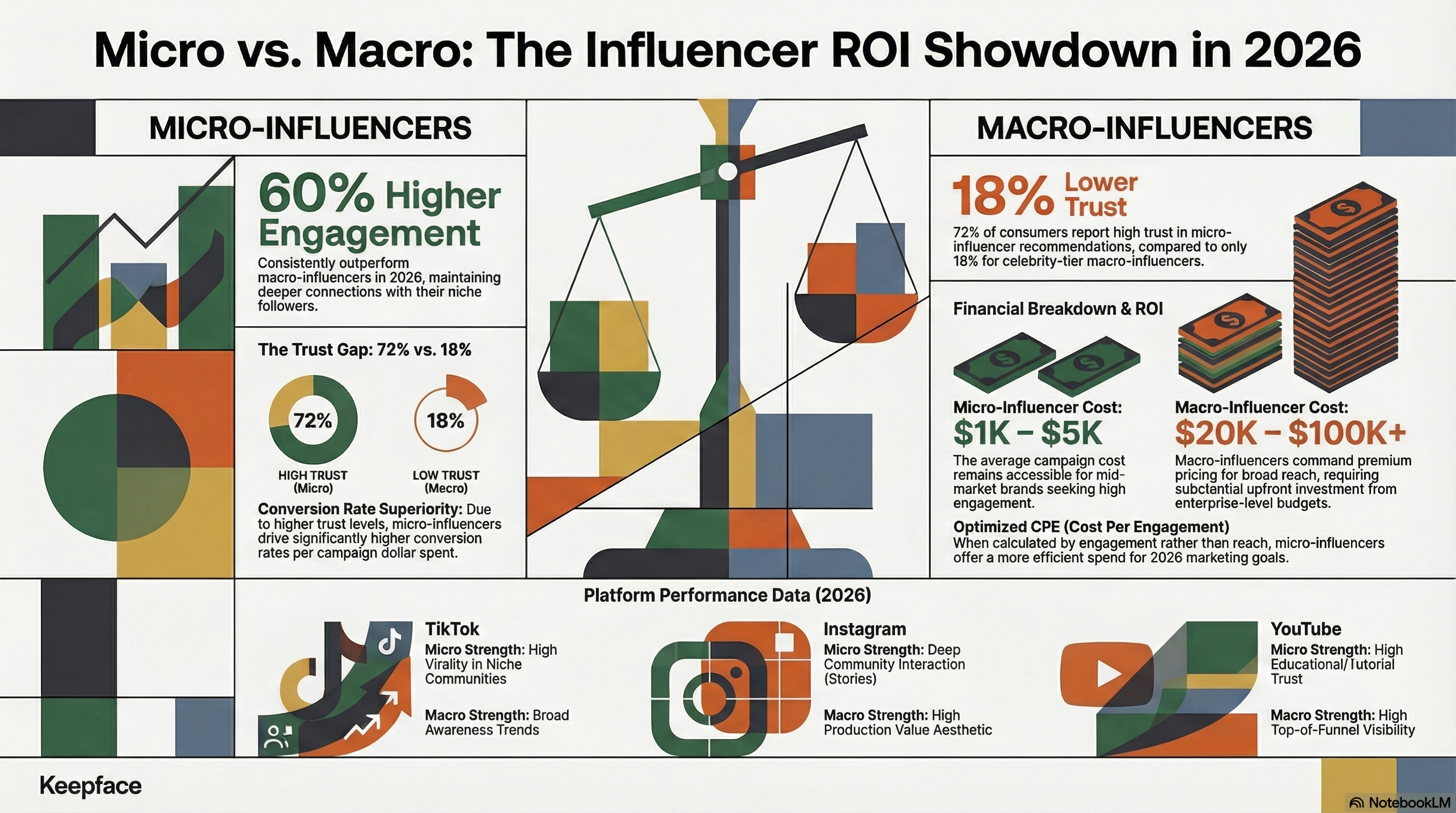
Micro-influencers generate 60% higher engagement than macro-influencers in 2026, yet most marketing teams still default to the biggest name their budget can reach. The result is inflated cost-per-acquisition, poor audience-to-product fit, and followers who scroll past without converting. This post gives you the full data comparison across engagement, cost, ROI, and use cases so you can pick the right tier for each campaign.
Find vetted micro and macro influencers on Keepface: pay-per-outreach, no subscription needed.
- What Is the Difference Between Micro and Macro Influencers?
- Engagement and Reach: The Real Numbers in 2026
- Real Cost Breakdown: What Brands Pay Per Tier
- ROI Comparison: Who Delivers More Per Dollar
- Real Case Study: 50 Micro vs 1 Macro on a $10,000 Budget
- When to Use Micro vs Macro Influencers
- The Keepface Approach to Influencer Tier Selection
- Key Takeaways
- FAQ
- Conclusion
What Is the Difference Between Micro and Macro Influencers?
Quick answer: The influencer marketing industry uses follower count as the primary tier classifier. Micro-influencers sit in the 10,000 to 100,000 follower range, while macro-influencers occupy the 100,000 to 1,000,000 range. Each tier has distinct audience characteristics, content behavior, and pricing dynamics.
The full tier breakdown from nano to mega looks like this:
| Tier | Followers | Avg Engagement Rate | Best For |
|---|---|---|---|
| Nano | 1K – 10K | 5% – 10% | Hyper-local, test campaigns |
| Micro | 10K – 100K | 3.5% – 8% | Niche conversion, high-trust |
| Macro | 100K – 1M | 1% – 3% | Brand awareness, reach |
| Mega / Celebrity | 1M+ | 0.5% – 1.5% | Mass brand positioning |
The engagement rate data is the first clue that follower count does not correlate linearly with campaign impact. A creator with 30,000 genuinely interested followers who engage at 6% is more valuable for most conversion campaigns than a macro-influencer at 800,000 followers engaging at 1.2%.
Beyond the numbers, micro-influencers tend to operate in specific niches: fitness, parenting, sustainable fashion, personal finance, or specific geographies. Their audiences follow them because of shared values and interests, not simply because they are famous. That audience composition drives the trust advantage that powers micro-influencer conversion rates.
Engagement and Reach: The Real Numbers in 2026
Quick answer: Micro-influencers average 3.5% to 8% engagement on Instagram and 5% to 11% on TikTok. Macro-influencers average 1% to 3% on Instagram and 2% to 4% on TikTok. The gap is widening as platforms algorithmically favor content that sparks genuine interaction.
The engagement advantage of micro-influencers has been consistent for three years, but 2026 data shows the gap widening on TikTok specifically. TikTok’s algorithm distributes content based on watch time, completion rate, and shares, metrics that favor authentic niche creators over polished macro-influencer productions.
Instagram Engagement Rate by Tier (2026)
Nano (1K-10K)
7.5% avg ER
Micro (10K-100K)
5.5% avg ER
Macro (100K-1M)
2.1% avg ER
Mega (1M+)
0.9%
Source: InfluencerMarketingHub Benchmark Report 2026
This matters because most brands measure campaign success by engagement rate before conversion. A macro-influencer post with 2% engagement on 500,000 followers generates 10,000 interactions. A single micro-influencer post at 5.5% engagement on 40,000 followers generates 2,200 interactions. That sounds like a macro win until you run the same budget through 15 micro-influencers: 15 x 2,200 = 33,000 interactions at the same cost or less.
The trust dimension compounds this. Research from InfluencerMarketingHub shows that 72% of consumers trust micro-influencer recommendations, compared to only 18% for celebrity endorsements. Trust directly impacts click-through rate and purchase intent, which is why micro-influencers consistently outperform on cost-per-conversion even when macro-influencers win on raw reach.
Real Cost Breakdown: What Brands Pay Per Tier
Quick answer: Micro-influencer posts cost $100 to $1,000 per sponsored post on Instagram. Macro-influencer posts run from $5,000 to $25,000. The cost-per-engagement gap is dramatic: expect to pay 8x to 15x more per interaction when working with macro-influencers.
| Tier | Followers | Instagram Post Cost | TikTok Post Cost | YouTube Integration |
|---|---|---|---|---|
| Nano | 1K – 10K | $10 – $100 | $5 – $75 | $50 – $200 |
| Micro | 10K – 100K | $100 – $1,000 | $75 – $750 | $200 – $2,000 |
| Macro | 100K – 1M | $5,000 – $25,000 | $3,000 – $15,000 | $10,000 – $50,000 |
| Mega / Celebrity | 1M+ | $25,000+ | $15,000+ | $50,000+ |
These are per-post rates. Most campaigns negotiate packages: a story + feed post + reel bundle, or a 3-month ambassador agreement. The blended cost-per-thousand-impressions (CPM) for micro-influencers typically runs $20 to $60, compared to $75 to $150 for macro-influencers. The cost-per-engagement gap is even wider because engagement rate drops sharply as follower count increases.
For SMBs with budgets under $10,000 per month, working exclusively with macro-influencers means 1 to 3 posts total. The same budget deployed across micro-influencers can generate 20 to 50 posts across different niches, platforms, and audiences, creating compounding brand exposure and diversified social proof.
For enterprise brands with six-figure monthly budgets, macro-influencers serve a specific function: establishing authority quickly in new markets or launching new product lines where rapid awareness matters more than immediate conversion.

ROI Comparison: Who Delivers More Per Dollar
Quick answer: Micro-influencers deliver 6x to 8x ROI per dollar for conversion-focused campaigns. Macro-influencers deliver 3x to 5x for awareness-focused campaigns. The global average across all influencer tiers is $5.78 per dollar spent, with top-performing campaigns reaching $18 to $20 per dollar.
ROI measurement in influencer marketing has matured significantly. Brands now track cost-per-engagement (CPE), cost-per-click (CPC), cost-per-acquisition (CPA), and earned media value (EMV) in addition to reach and impressions. When any of these conversion-adjacent metrics are used as the primary KPI, micro-influencers consistently outperform.
The structural reason is audience composition. A macro-influencer with 600,000 followers in fashion has a diffuse audience spanning all ages, geographies, income levels, and purchasing behaviors. A micro-influencer with 45,000 followers in sustainable skincare has a self-selected audience of people actively interested in eco-friendly beauty products. When a sustainable skincare brand promotes through the micro-influencer, the audience match is near-perfect. When it promotes through the fashion macro-influencer, most of the reach is wasted on people with zero purchase intent for that category.
Cost-per-conversion comparison across real campaign data shows micro-influencer CPA running 30% to 50% lower than macro-influencer CPA in most verticals, including beauty, food, fitness, and home goods. The exception is luxury goods and global brand launches, where the prestige signal of a mega-influencer partnership generates brand equity that does not show up in CPA metrics but drives long-term revenue.
Real Case Study: 50 Micro vs 1 Macro on a $10,000 Budget
Quick answer: On the same $10,000 budget, 50 micro-influencer posts typically outperform a single macro-influencer post by 3x to 5x on total engagement, 2x on link clicks, and 4x on conversions for conversion-focused campaigns.
Here is how the comparison plays out for a direct-to-consumer health supplement brand running a product launch campaign:
Option A: 1 Macro-Influencer
- Creator: Fitness macro-influencer, 450,000 Instagram followers
- Cost: $10,000 (1 feed post + 3 stories)
- Reach: 450,000
- Engagement rate: 1.8%
- Total engagements: 8,100
- Story link clicks: 1,200
- Estimated conversions: 60 (5% click-to-purchase)
- CPA: $166.67
Option B: 50 Micro-Influencers
- Creators: 50 fitness/wellness micro-influencers, avg 25,000 followers each
- Cost: $200 per creator = $10,000 total
- Total reach: 1,250,000 (50 x 25,000)
- Engagement rate: 5.2% average
- Total engagements: 65,000
- Swipe-up / link clicks: 4,500
- Estimated conversions: 225 (5% click-to-purchase)
- CPA: $44.44
The micro-influencer option delivers 8x the engagements, 3.75x the conversions, and 3.75x lower CPA on the same $10,000 investment. The macro-influencer option delivers higher per-post brand prestige and concentrated awareness in a single creator’s context, which has value for brand positioning but not for direct conversion.
When to Use Micro vs Macro Influencers
Quick answer: Choose micro-influencers for conversion, niche targeting, and budget efficiency. Choose macro-influencers for brand launches, prestige signaling, and entering new markets fast. Most successful 2026 brand strategies use a hybrid model: macro for awareness, micro for conversion.
Choose micro-influencers when:
- Your primary KPI is CPA, CPC, or direct sales conversion
- Your product targets a specific niche (e.g., keto dieters, plant-based parents, remote workers)
- Your monthly budget is under $50,000 and you want maximum post volume and diversification
- You are testing a new product or market and want low-risk A/B validation across multiple audiences
- You need authentic testimonial-style content that drives trust before purchase
- You want to build long-term ambassador relationships with creators who are genuinely aligned with your brand
Choose macro-influencers when:
- Your campaign goal is brand awareness at scale within a defined timeframe
- You are launching a product and want to create a cultural moment or trending conversation
- Your target audience is broad (e.g., all women aged 25-45 who use skincare) rather than niche-specific
- You are entering a new geographic market and need fast credibility transfer
- Your product has aspirational appeal where celebrity association adds perceived value
- You need content at production quality levels that most micro-influencers cannot match
Hybrid approach (recommended for budgets above $30,000/month):
- Allocate 30% to 1 to 2 macro-influencers for brand-building reach
- Allocate 70% to 20 to 50 micro-influencers for conversion and audience-specific penetration
- Let macro content establish credibility; use micro content to drive clicks and purchases

The Keepface Approach to Influencer Tier Selection
Quick answer: Keepface gives brands direct access to 550,000+ verified creators across 40+ countries, with AI-powered matching to filter by tier, engagement rate, niche, and audience demographics, without a subscription or agency markup.
The core challenge with influencer tier selection is not deciding which tier to use in theory. It is finding and vetting the right individual creators in that tier efficiently at scale. Working with 50 micro-influencers manually through DMs and spreadsheets takes weeks. Most brands either give up and default to 1 macro-influencer for simplicity, or hire an agency that adds 30% to 50% overhead to the creator cost.
Keepface solves this with a pay-per-outreach model. Brands do not pay a monthly subscription. They pay only when they contact a creator. The platform handles verified creator profiles, audience authenticity checks, and multi-channel outreach (email, Instagram DM, WhatsApp, Telegram) simultaneously. A brand can contact 50 vetted micro-influencers in 30 minutes rather than 3 weeks.
The AI matching layer filters candidates by:
- Follower tier (nano, micro, macro, mega)
- Engagement rate thresholds (set your minimum)
- Audience demographics (age, gender, location)
- Content niche and topic affinity
- Past campaign performance signals
- Audience authenticity score (fraud detection)
For brands running multi-tier strategies, Keepface allows simultaneous campaigns targeting both micro and macro creators from the same campaign dashboard. You set the budget, define the tier split, and the platform surfaces the best-matched creators for each segment.
With 40+ countries covered and verified local creators in markets from Turkey to the UAE to Romania, Keepface is particularly effective for brands running regional campaigns where local language and cultural alignment matter as much as follower count.
Key Takeaways
- Micro-influencers (10K-100K followers) generate 60% higher engagement rates than macro-influencers on average in 2026.
- 72% of consumers trust micro-influencer recommendations, compared to just 18% for celebrity endorsements : trust drives conversion.
- Macro-influencer Instagram posts cost $5,000 to $25,000; micro-influencer posts cost $100 to $1,000, a 5x to 25x cost difference per post.
- On the same $10,000 budget, 50 micro-influencers outperform 1 macro-influencer by 3.75x in conversions and reduce CPA by 73% for conversion campaigns.
- Micro-influencers deliver 6x to 8x ROI per dollar for conversion campaigns; macro-influencers deliver 3x to 5x for awareness campaigns.
- The 30/70 budget split (30% macro for awareness, 70% micro for conversion) is the dominant model for brands with budgets above $30,000 per month.
- TikTok engagement rates of 5% to 11% for micro-influencers consistently outperform Instagram and make it the highest-ROI platform for micro-influencer campaigns in 2026.
- Keepface’s pay-per-outreach model removes the scale barrier to running 50-creator micro-influencer campaigns without agency overhead or subscription costs.
FAQ
What is the difference between micro and macro influencers?
Micro-influencers have 10,000 to 100,000 followers and are defined by high engagement rates (3.5% to 8%) and niche audience composition. Macro-influencers have 100,000 to 1 million followers and offer broader reach at lower engagement rates (1% to 3%). The key distinction is not just scale but audience specificity: micro-influencers’ followers are typically there for a shared interest, while macro-influencers attract more diverse, general audiences. For most conversion-focused campaigns, the audience specificity of micro-influencers delivers more predictable results at lower cost.
Are micro-influencers better than macro-influencers for driving sales?
Yes, for most direct-response and conversion campaigns, micro-influencers outperform macro-influencers on cost-per-acquisition. Micro-influencers generate 20% higher conversion rates and 60% higher engagement rates than macro-influencers according to 2026 benchmark data. The trust advantage compounds this: audiences perceive micro-influencer recommendations as genuine endorsements rather than paid promotions, which increases purchase intent. Macro-influencers perform better when the goal is brand awareness, prestige association, or rapid reach in a new market rather than immediate sales conversion.
How do you calculate influencer marketing ROI?
The standard formula is: ROI = (Revenue Generated – Campaign Cost) / Campaign Cost x 100. For attribution, use UTM-tracked links to measure traffic and conversions from each creator. More granular metrics include: cost-per-engagement (CPE = total spend / total engagements), cost-per-click (CPC = total spend / link clicks), and cost-per-acquisition (CPA = total spend / confirmed purchases). Earned media value (EMV) captures the estimated cost of equivalent organic reach. Compare these metrics across tiers to identify which creator types deliver the strongest return for your specific product and audience.
How much does a micro-influencer campaign cost in 2026?
A single micro-influencer post on Instagram costs $100 to $1,000 depending on follower count, engagement rate, and content type (feed post vs reel vs story). A TikTok post from the same creator typically runs slightly less: $75 to $750. For a 20-creator micro-influencer campaign, expect to budget $2,000 to $20,000 for post fees, plus 10% to 15% for platform or tool costs. On platforms like Keepface, outreach fees are paid per contact rather than per campaign, which removes the overhead barrier for brands testing micro-influencer campaigns at low initial investment.
What engagement rate should I expect from micro-influencers?
A healthy micro-influencer delivers 3.5% to 8% engagement rate on Instagram and 5% to 11% on TikTok. Nano-influencers (1K to 10K) often exceed these benchmarks with rates of 7% to 10% due to highly personal audience relationships. Rates below 2% on Instagram for a micro-influencer should prompt an authenticity audit: check follower growth patterns, comment quality, and audience geography. Platforms like Keepface apply audience authenticity scoring to every creator profile so you do not need to run manual fraud checks before outreach.
Conclusion
The micro vs macro influencer question does not have a single right answer, but the data in 2026 makes the decision framework clear. For conversion campaigns, budget efficiency, and niche audience targeting, micro-influencers deliver superior ROI by a significant margin. For brand launches, prestige positioning, and large-scale awareness, macro-influencers serve a distinct and valuable purpose. The most effective campaigns in 2026 use both: macro-influencers to build cultural context, micro-influencers to convert that awareness into revenue.
The practical barrier is scale. Running a 50-creator micro-influencer campaign manually is too slow and expensive without the right infrastructure. Keepface solves that with 550,000+ verified creators across 40+ countries, AI-powered matching to find the right tier and niche fit, and a pay-per-outreach model that removes subscription overhead entirely.