
Social Commerce Influencer Marketing in 2026: Full Strategy Guide
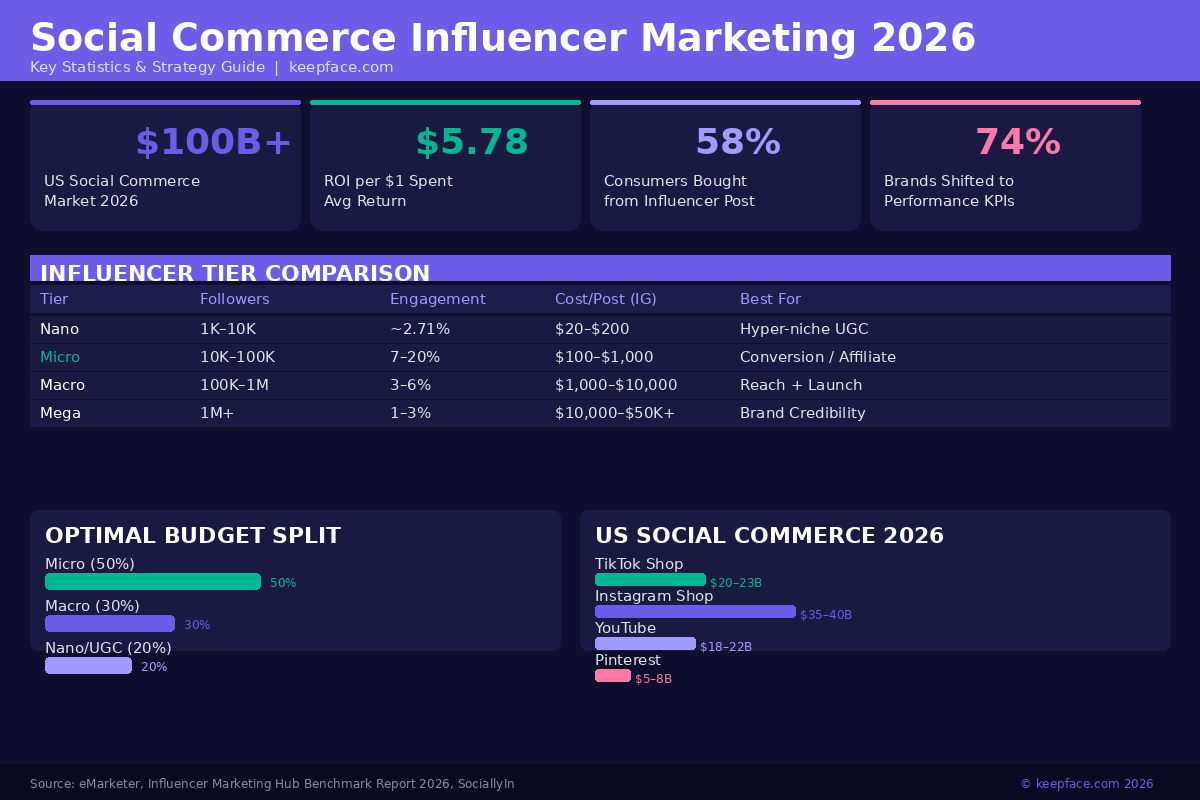
What is social commerce influencer marketing? Social commerce influencer marketing is the practice of partnering with creators on platforms like TikTok and Instagram to drive direct product purchases within the social feed: combining influencer trust with native checkout to shorten the path from discovery to sale. In 2026, US social commerce is projected to surpass $100 billion, making in-feed purchase campaigns the single highest-ROI channel in digital marketing.
US social commerce is on track to surpass $100 billion in 2026, yet most brands still run influencer campaigns built for awareness: not conversion. The brands winning right now have made one shift: they put direct purchase pathways inside every creator post.
This guide covers the platforms, tiers, tactics, and cost models that make social commerce influencer campaigns work in 2026.
Launch your social commerce campaign on Keepface: pay-per-outreach, no subscription needed →
- Why Social Commerce Is Now the Default Influencer Channel
- Which Platforms Drive the Most Social Commerce Revenue
- Influencer Tiers for Social Commerce: Who to Work With
- Real Cost Breakdown: What Brands Pay for Social Commerce Campaigns
- Real Case Study: 200 Outreach, 4.1x ROAS
- How to Run a Social Commerce Influencer Campaign: Step-by-Step
- The Keepface Approach for Social Commerce
- Key Takeaways
- FAQ
Why Social Commerce Is Now the Default Influencer Channel
Quick answer: Because 58% of consumers aged 18+ have already made a purchase directly from an influencer post: and platforms now make it technically seamless.
The shift happened gradually, then all at once. Between 2020 and 2026, the global influencer marketing market tripled to $34 billion. What changed wasn’t just the size: it was the mechanics. TikTok Shop launched. Instagram Checkout matured. YouTube integrated product links natively. The gap between “I saw a creator use this” and “I bought it” collapsed from days to seconds.
Three forces are converging in 2026 that make social commerce the primary influencer use case:
1. Performance budgets are replacing awareness budgets. A striking 74% of brands are now moving creator program funding into campaigns measured by sales, not impressions. Brands that ran awareness-only influencer campaigns in 2024 are being asked to show conversion data: and those that ran social commerce campaigns are showing $5.78 returned per $1 spent on average, with top performers returning $18-$20.
2. Nano and micro-influencers convert better than mega creators. Nano-influencers (1K-10K followers) average 2.71% engagement on Instagram: roughly 50% higher than micro-influencers. More importantly, they convert: micro-influencer campaigns run 20% higher conversion rates than other tiers because audiences treat their recommendations as peer referrals, not advertising.
3. AI is making it scalable. In 2026, 60.2% of marketers use AI for creator identification and campaign optimisation. What previously required weeks of manual outreach: identifying, vetting, briefing, and tracking 50+ creators: now takes hours on AI-native platforms.
Social Commerce Growth: US Market (USD Billion)
2024
$67B
2025
$83B
2026
$100B+
Source: eMarketer US Social Commerce Forecast 2026

Which Platforms Drive the Most Social Commerce Revenue
Quick answer: TikTok Shop leads for Gen Z conversion; Instagram Shopping leads for total revenue volume; YouTube drives the highest-value purchases through long-form review content.
Each platform has a distinct social commerce mechanic in 2026:
TikTok Shop is projected to generate $20-23 billion in US sales in 2026. The platform’s For You Page algorithm gives unknown creators: not just mega influencers: the ability to go viral with product content. The native checkout experience means viewers never leave TikTok to buy. The sweet spot: micro-creators in niches (beauty, home, fashion, food) running affiliate-style campaigns where they earn commission on sales they drive.
Instagram Shopping is where 80%+ of marketers still run their influencer campaigns. Reels with product tags drive the highest click-through; Stories with swipe-up links perform best for flash sales and time-sensitive offers. Engagement rates on Instagram Reels (7.9%) are now statistically equivalent to TikTok (7.4-8.1%), making it a near-equal platform for conversion content.
YouTube dominates for high-consideration purchases. The platform’s long-form review format allows creators to provide depth that drives purchase confidence. A single mid-roll product mention in a 500K-view video regularly outperforms 10 Instagram posts in units sold for products priced above $100.
Pinterest is the underutilised social commerce platform in 2026. Pinterest users are in active buying mode: 85% of Pinners make purchases based on content they see on the platform. For brands in home, fashion, and beauty, Pinterest influencer campaigns deliver conversion rates 3x higher than equivalent Instagram campaigns.
Influencer Tiers for Social Commerce: Who to Work With
Quick answer: For social commerce, nano and micro-influencers deliver the best cost-per-conversion. Macro and mega tiers serve awareness: conversion comes from volume at the smaller tiers.
| Tier | Followers | Avg Engagement | Cost/Post (IG) | Best For |
|---|---|---|---|---|
| Nano | 1K-10K | 2.71% | $20-$200 | Hyper-niche, authentic UGC |
| Micro | 10K-100K | 7-20% | $100-$1,000 | Conversion, affiliate campaigns |
| Macro | 100K-1M | 3-6% | $1,000-$10,000 | Awareness + launch amplification |
| Mega/Celebrity | 1M+ | 1-3% | $10,000-$50,000+ | Brand credibility, mass awareness |
The most effective social commerce budgets in 2026 follow a 50-30-20 model: 50% to micro-influencers for conversion volume, 30% to macro for reach amplification, 20% to nano/UGC creators for authentic reviews that feed retargeting ads.
Why does this split work? Micro-influencer cost-per-engagement is $0.20 versus $0.33 for macro: a 65% premium for macro that rarely translates into proportionally better conversion. For a $10,000 campaign budget, running 20 micro-influencers at $500 each will typically outperform 2 macro influencers at $5,000 each in units sold.

Real Cost Breakdown: What Brands Pay for Social Commerce Campaigns
Quick answer: Entry-level social commerce campaigns start at $2,000-$5,000 for a 10-creator micro-influencer push. Mid-market campaigns run $10,000-$30,000. Enterprise brand launches exceed $100,000.
Here is what the budget actually covers:
Small brand / DTC launch ($2,000-$5,000): 10-20 nano/micro-influencers on TikTok or Instagram. Product gifting + small flat fee per creator. Goal: seed UGC, test product-market fit in social commerce. Expected ROAS: 2x-4x.
Growing brand ($10,000-$30,000): 20-50 micro-influencers across 2 platforms. Mix of affiliate commissions (5-15% per sale) and flat fees ($200-$600 per creator). Dedicated landing pages with UTM tracking. Expected ROAS: 4x-8x.
Enterprise / seasonal campaign ($50,000+): 100+ creators across nano, micro, and 2-3 macro anchors. Full content licensing rights. Platform-native shopping integration (TikTok Shop product catalogue, Instagram Shopping tags). Expected ROAS: 6x-18x for top-performing verticals.
The most reliable cost benchmark in 2026: micro-influencer CPE of $0.20 means a $5,000 campaign with 25,000 total engagements is on target. Anything below $0.15 CPE is exceptional; above $0.40 CPE means the tier or platform mix needs review.
Launch your social commerce campaign on Keepface: start from $0.25 per influencer outreach →
Real Case Study: 200 Outreach, 4.1x ROAS
A mid-market beauty brand ran the following campaign in Q1 2026:
- Platform: TikTok Shop + Instagram Reels
- Creators contacted: 200 micro-influencers (15K-80K followers)
- Response rate: 34% (68 creators accepted)
- Content produced: 68 TikTok videos + 41 Instagram Reels
- Campaign budget: $12,000 (flat fees + product gifting)
- Total views: 4.2 million across all content
- Direct purchases attributed: 1,847 units
- Revenue generated: $49,200 (avg $26.65 per unit)
- ROAS: 4.1x
Key insight: The top 12 creators (18% of the total) drove 61% of all attributed revenue. This is the Pareto distribution that every social commerce campaign manager should plan for. Running 200 outreach to find those 12 high-performers is not inefficiency: it is the model.
How to Run a Social Commerce Influencer Campaign: Step-by-Step
Quick answer: The six steps below move a social commerce campaign from brief to measurable ROAS in 3-4 weeks.
- Define the purchase pathway first. Before briefing any creator, decide where the purchase happens: TikTok Shop affiliate link, Instagram Shopping tag, or a branded landing page with UTM. The purchase pathway determines your content brief, not the other way around.
- Build a creator list by niche affinity, not just follower count. A 15,000-follower skincare reviewer who has mentioned your product category in 3+ previous posts will outperform a 150,000-follower lifestyle creator who covers everything. Use audience demographics data to confirm 60%+ match with your target buyer.
- Run volume outreach: expect 25-35% response rate. Contact 3x more creators than you need. A healthy benchmark is 30% acceptance rate on a well-structured brief with fair compensation. Platforms with AI outreach tools can handle this at scale without manual follow-up.
- Brief for authenticity, not production value. Social commerce content that feels native to the platform (casual, first-person, spontaneous) consistently outperforms polished brand-controlled content. Give creators talking points and product benefits: not scripts.
- Track with UTM + platform-native attribution. Every creator gets a unique affiliate link or UTM parameter. TikTok Shop and Instagram Shopping have native attribution dashboards. Stack UTM data on top for cross-platform reporting.
- Identify top performers and re-contract immediately. Within 72 hours of posting, you will see which creators drove the most clicks and conversions. Approach them for a long-term ambassador arrangement before competitors do.
The Keepface Approach for Social Commerce Campaigns
Quick answer: Keepface’s pay-per-outreach model is built for social commerce volume campaigns: you only pay when you reach a verified creator, not for a platform subscription.
Social commerce success depends on outreach volume. Finding the 12 top-performing creators means contacting 150-200. Most influencer platforms charge $500-$3,000 per month for access: before you’ve contacted a single creator. That subscription cost comes out of your ROAS before the campaign starts.
Keepface works differently:
- 2,000,000+ verified creators across Instagram, TikTok, YouTube, and emerging platforms
- Pay-per-outreach: you pay only when you contact a creator, not for platform access
- AI-powered matching: filters by niche, audience demographics, engagement quality, and social commerce history
- Multi-channel outreach: Email, WhatsApp, and Telegram in a single workflow
- 6,000+ brands have run campaigns through Keepface across 15+ markets
For a $10,000 social commerce campaign, Keepface’s model means more of that budget goes to creator compensation (which drives ROAS) and less to platform fees.
Key Takeaways
- US social commerce is projected to surpass $100 billion in 2026: the channel is now too large to treat as experimental
- 58% of consumers 18+ have made a purchase directly from an influencer post; brands without a purchase pathway in their creator briefs are leaving conversions on the table
- Average influencer marketing ROI: $5.78 per $1 spent; top social commerce campaigns return $18-$20 per $1
- Micro-influencers (10K-100K) deliver 65% lower cost-per-engagement than macro and convert 20% higher: the best tier for social commerce volume
- TikTok Shop is projected to generate $20-23B in US sales in 2026; Instagram Shopping serves the broadest audience; YouTube drives highest-value purchases
- The optimal social commerce budget split: 50% micro, 30% macro, 20% nano/UGC
- Expect a 25-35% creator acceptance rate on outreach: always contact 3x your target creator count
- Keepface’s pay-per-outreach model lets brands run high-volume creator discovery without subscription costs eating into ROAS
FAQ
What is social commerce influencer marketing?
Social commerce influencer marketing is creator-driven selling that happens entirely within a social platform: viewers discover a product through a creator’s post and purchase without leaving the app. It combines the trust of influencer endorsement with the friction-free experience of native checkout on platforms like TikTok Shop and Instagram Shopping. In 2026, this model is the primary conversion channel for DTC and beauty brands, delivering average ROI of $5.78 per $1 spent.
Is micro-influencer social commerce better than macro for ROI?
Yes, for most brands. Micro-influencers (10K-100K followers) deliver 7-20% engagement rates versus 3-6% for macro, and their cost-per-engagement is $0.20 versus $0.33 for macro: a 65% difference. For social commerce specifically, micro-influencer audiences convert 20% higher because they view creator recommendations as peer referrals rather than advertising. The exception is product launches where macro creators provide reach amplification that micro alone cannot match.
How do I calculate social commerce influencer ROI?
Use this formula: ROAS = Total Revenue Attributed / Total Campaign Spend. Track revenue attribution through UTM parameters on each creator’s unique link, or through platform-native attribution (TikTok Shop affiliate dashboard, Instagram Shopping insights). For a $10,000 campaign that generates $41,000 in sales, ROAS is 4.1x. Industry benchmark for well-run social commerce campaigns in 2026 is 3x-8x ROAS for micro-influencer heavy campaigns in the beauty and fashion verticals.
How much does a social commerce influencer campaign cost in 2026?
Entry-level: $2,000-$5,000 for 10-20 nano/micro-influencers on TikTok or Instagram with product gifting plus small fees. Mid-market: $10,000-$30,000 for 20-50 micro-influencers across two platforms with affiliate commissions and UTM tracking. Enterprise: $50,000+ for 100+ creators with macro anchors, full content licensing, and TikTok Shop product catalogue integration. The cost per creator ranges from $20 (nano) to $10,000+ (macro) per post on Instagram; TikTok rates run approximately 50% lower.
What ROAS should I expect from a social commerce influencer campaign?
For a first-time social commerce campaign: 2x-4x ROAS is a realistic baseline if you are new to creator commerce. Optimised campaigns running micro-influencer affiliate models with good product-market fit regularly hit 4x-8x. Top-performing brands in beauty and fashion: with established creator relationships and TikTok Shop affiliate programmes: report 8x-20x. The key variable is creator-audience alignment: a nano-influencer with 5,000 highly engaged followers in your exact product niche will outperform a macro with 500,000 generic followers every time.
Conclusion
Social commerce is not the future of influencer marketing: it is the present. With US social commerce surpassing $100 billion in 2026 and 74% of brands shifting budgets to performance-driven creator campaigns, the question is no longer whether to run social commerce influencer campaigns. It is how to run them efficiently at scale.
The formula is straightforward: lead with micro-influencers for conversion, add macro anchors for reach, build in a frictionless purchase pathway from day one, and measure everything with UTM or native platform attribution. The brands achieving $5.78-$18 ROI per $1 spent are not doing anything extraordinary: they are doing the fundamentals at volume.