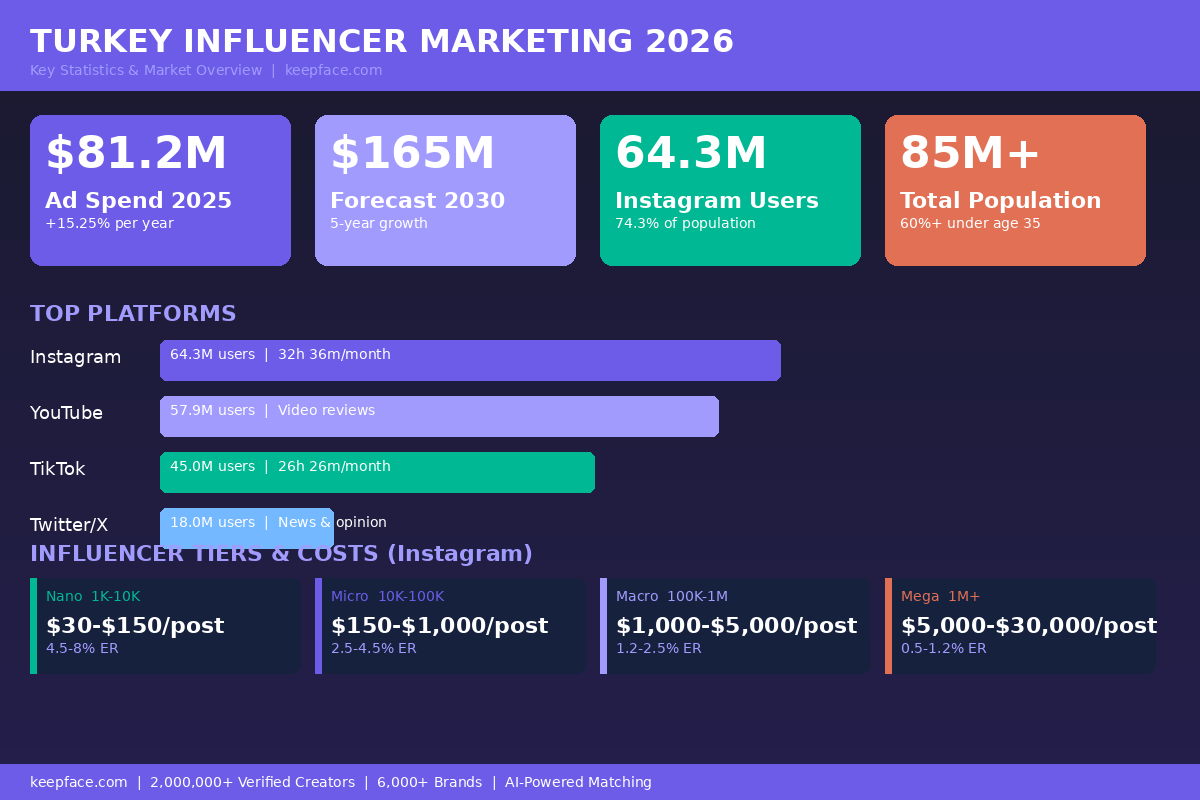
What is influencer marketing in Turkey? Influencer marketing in Turkey involves brands partnering with verified Turkish creators on Instagram, TikTok, YouTube, and Twitter/X to reach the country’s 64 million-plus social media users. With ad spend reaching $81.2 million in 2025 and forecast to hit $165 million by 2030, Turkey is one of Europe’s fastest-growing influencer markets driven by a young, digitally native population.
Turkey’s influencer marketing sector grew to $81.2 million in ad spend during 2025, growing at 15.25% annually. With 64.3 million Instagram users spending over 32 hours per month on the platform, Turkish audiences are among the most engaged in the world. Yet most international brands have barely tapped this market, leaving significant reach and ROI on the table.
This guide covers everything brands and marketers need to know: which platforms dominate, what influencer tiers cost in Turkey, which niches convert, and how to run a campaign from start to finish without burning budget on the wrong creators.
Find verified Turkish influencers on Keepface. Pay-per-outreach, no subscription needed →
- Why Turkey Is a Growing Influencer Marketing Market
- Top Social Media Platforms in Turkey
- Influencer Tiers in Turkey: Costs and Reach
- Content Niches That Perform Best in Turkey
- How Much Does Influencer Marketing Cost in Turkey?
- Running a Campaign in Turkey: Step-by-Step
- The Keepface Approach for Turkey Campaigns
- Key Takeaways
- FAQ
Why Turkey Is a Growing Influencer Marketing Market
Quick answer: Turkey combines Europe’s largest young-adult population with one of the region’s most digitally active social media cultures, creating a rare market where micro-influencer campaigns consistently outperform paid social ads.
Turkey has 85 million people, and over 60% of them are under 35. That demographic concentration drives social media adoption rates that rival South Korea and Brazil. As of late 2025, the country counted 62.3 million active social media users, equal to 70.9% of the total population, with penetration forecast to reach 86% by 2026.
The economic angle is equally compelling. Turkey’s digital advertising market is projected to grow 10.3% in 2026, reaching $3.26 billion in total ad spend. Within that, influencer marketing specifically is on a faster growth curve: $81.2 million in 2025 at a 15.25% compound annual growth rate, with the sector forecast to reach $165.1 million by 2030.
Turkey Influencer Marketing Market Size (USD Million)
2023
$61.1M
2025
$81.2M
2030
$165.1M
Source: Statista, influencer advertising revenue forecast, Turkey 2023-2030
Several structural factors explain this growth trajectory. First, Turkey’s e-commerce sector is expanding fast, and influencer-led product discovery is the primary acquisition channel for Turkish online shoppers, particularly in fashion, beauty, electronics, and food delivery. Second, Turkish audiences apply high trust to creators they follow consistently, which translates into above-average click-through and conversion rates for brand collaborations. Third, a growing pool of full-time Turkish content creators has professionalized their offerings, making it easier for brands to find creators with trackable metrics and clean content histories.
Top Social Media Platforms in Turkey
Quick answer: Instagram dominates with 64 million users and 32 hours of monthly average usage, but TikTok is the fastest-growing platform for Gen Z reach, and YouTube holds strong for long-form content and product review searches.
Understanding where Turkish audiences spend their time is the first step in any campaign planning process. Each platform has distinct audience demographics, content formats, and engagement norms in Turkey.
Instagram is the undisputed leader. Turkey had 64.3 million Instagram users as of August 2025, representing 74.3% of the entire population. Turkish users spend an average of 32 hours and 36 minutes per month on Instagram, one of the highest figures anywhere in Europe and the Middle East. Instagram penetration among Turkish social media users is approximately 92%, making it the near-universal choice for influencer campaigns across every category from fast fashion to home appliances.
TikTok is the second most time-consuming platform, with Turkish users averaging 26 hours and 26 minutes per month. TikTok skews younger in Turkey, with Gen Z creators in humor, dance, beauty, and lifestyle content attracting millions of followers. For brands targeting 18-28-year-old consumers, TikTok is often the more cost-efficient option relative to Instagram, with nano and micro creators charging significantly lower rates per post.
YouTube has 57.9 million users in Turkey and serves a different content purpose: long-form reviews, tutorials, and educational content. Turkish YouTube creators in technology, gaming, cooking, and travel niches build highly loyal subscriber bases that are particularly valuable for considered purchases where the viewer needs detailed information before buying.
Twitter/X remains relevant in Turkey, especially for news, opinion, and cultural commentary. Turkish Twitter culture is highly opinionated and fast-moving. Brands in fintech, media, and current affairs can find relevant influencer voices on the platform, but direct product promotion is less common than on Instagram or TikTok.
Telegram plays a supporting role as a community platform, with many Turkish content creators running Telegram channels alongside their primary social profiles for exclusive content and deeper audience engagement.
Turkey Social Media Platform Reach (Millions of Users, 2025)
Instagram
64.3M users
YouTube
57.9M users
Social (all)
62.3M active
Source: DataReportal Digital 2026 Turkey, NapoleonCat August 2025
Influencer Tiers in Turkey: Costs and Reach
Quick answer: Turkey’s influencer pricing is significantly lower than Western European and US markets, making it possible for brands to run multi-creator campaigns at budgets that would cover only a single macro creator in the UK or Germany.
Turkish influencer pricing reflects the local economic context while still tracking global platform dynamics. Rates have stabilized after a period of lira depreciation, and most established Turkish creators now quote prices in USD for international brand deals.
| Tier | Followers | Instagram Post | TikTok Video | Avg Engagement |
|---|---|---|---|---|
| Nano | 1K-10K | $30-$150 | $20-$100 | 4.5-8% |
| Micro | 10K-100K | $150-$1,000 | $100-$700 | 2.5-4.5% |
| Macro | 100K-1M | $1,000-$5,000 | $700-$3,500 | 1.2-2.5% |
| Mega | 1M+ | $5,000-$30,000 | $3,500-$20,000 | 0.5-1.2% |
Nano-influencers in Turkey offer exceptional value. Their small but highly engaged communities, often centered on a specific city, neighborhood, or niche interest, deliver engagement rates between 4.5% and 8% on Instagram. For context, the global nano-influencer average engagement is 2.71%, so Turkish nano creators frequently outperform that benchmark. On TikTok, the gap is even more pronounced, with Turkish nano creators in trending niches reaching 10-12% engagement on viral posts.
Micro-influencers (10K-100K followers) represent the strongest ROI tier for most brand campaigns in Turkey. They have enough reach to move the needle on brand awareness and enough credibility to convert followers into buyers. A campaign working with 10-15 Turkish micro-influencers across Instagram and TikTok simultaneously can deliver broader, more authentic reach than a single macro placement at the same total budget.
Macro and mega influencers in Turkey are genuine celebrities in their niches. Fashion creators like Istanbul-based stylists with 500K-2M followers command rates comparable to mid-tier influencers in Germany or France, but with the advantage that their audiences are highly concentrated in a single market, making targeting far more efficient.
Launch your Turkey influencer campaign on Keepface from $0.25 per creator outreach →
Content Niches That Perform Best in Turkey
Quick answer: Fashion, beauty, food, gaming, and lifestyle are the five highest-performing niches for influencer content in Turkey, with e-commerce and tech following closely as growing categories.
Turkey’s content creator landscape has a distinct personality shaped by its location at the intersection of European trends and Middle Eastern cultural influences. This gives certain niches unique angles that do not exist in purely Western markets.
Fashion and style is the dominant niche. Istanbul has long been a fashion hub with a distinct aesthetic that blends Mediterranean casual with Middle Eastern-influenced modest fashion. Turkish fashion influencers appeal to domestic audiences and increasingly attract brand deals from European and Gulf-based fashion labels seeking to reach both markets simultaneously. Fast fashion, streetwear, modest fashion, and premium contemporary clothing all have thriving creator communities.
Beauty and skincare is the second-largest category and growing rapidly. Turkish beauty creators span both traditional makeup artistry and emerging skincare science content. The Turkish beauty market has strong domestic brands (such as Farmasi and Golden Rose) alongside growing penetration from international players, all of which actively use influencer campaigns for product launches and promotions.
Food and culinary content performs exceptionally well. Turkish food culture is rich and varied, and food creators covering traditional recipes, restaurant reviews, and street food have massive, loyal followings. For food and beverage brands entering Turkey or Turkish brands seeking to expand internationally, this niche offers a direct path to highly engaged audiences.
Gaming and esports is one of Turkey’s fastest-growing creator categories. Turkey has a young gaming population and several globally recognized esports teams. Gaming creators on YouTube, Twitch, and TikTok attract advertising from hardware brands, gaming accessories, and energy drink companies seeking Gen Z reach.
Lifestyle and travel round out the top five. Turkey’s geography spanning Europe, Asia, and the Mediterranean makes it a natural setting for aspirational lifestyle content. Creators documenting Istanbul life, Cappadocia visits, or Aegean coastal travel generate strong engagement from both domestic followers and the Turkish diaspora across Europe.

How Much Does Influencer Marketing Cost in Turkey?
Quick answer: A typical Turkey influencer campaign working with 10-15 micro-creators across Instagram and TikTok costs between $3,000 and $12,000. Nano-creator campaigns with 30-50 creators can achieve broader reach at $2,000-$6,000 total.
Campaign costs in Turkey depend on four main variables: influencer tier, platform, content format, and exclusivity requirements.
For small and medium businesses entering influencer marketing in Turkey for the first time, a realistic starting budget is $1,500-$4,000 for a nano-creator campaign. At this level, brands can work with 15-30 nano-influencers across Instagram or TikTok, generating authentic word-of-mouth content in a specific city or product niche. This approach works particularly well for local restaurant groups, regional e-commerce brands, beauty startups, and service businesses.
For mid-size brands running product launch or awareness campaigns, a $5,000-$15,000 budget unlocks a combination of micro and macro creators. A typical allocation might include 8-12 micro-creators producing Instagram Reels and Stories plus 2-3 macro creators for peak-day amplification. This structure balances authenticity (micro-creators) with reach (macro-creators).
For enterprise brands and international companies running quarterly campaigns, Turkey campaigns of $20,000-$50,000+ allow for full-funnel strategies: awareness with macro and mega creators at the top, conversion with micro-creators in the mid-funnel, and loyalty campaigns with nano-creator brand ambassadors over several months.
One cost efficiency advantage unique to Turkey: the country’s influencer supply is large relative to advertiser demand compared to markets like Germany or France. This means brands can negotiate favorable rates, especially for longer-term partnerships and exclusivity deals within a specific product category.
Platform-specific cost notes:
- Instagram Reels command the highest rates, typically 25-35% above static feed posts
- TikTok videos cost 30-40% less than equivalent Instagram placements for the same follower count
- YouTube integrations (dedicated reviews or mid-roll mentions) are priced higher but deliver longer content shelf life since search traffic continues to drive views for months after posting
- Instagram Stories are priced at roughly 30-50% of a feed post rate and are useful for direct-response campaigns with swipe-up links
Running a Campaign in Turkey: Step-by-Step
Quick answer: A successful Turkey influencer campaign follows six steps from market research through creator outreach, brief delivery, content review, publishing, and results measurement. Skipping the creator vetting step is the most common and costly mistake.
- Define your target audience segment. Turkey is not a monolithic market. Istanbul, Ankara, and Izmir have distinct consumer cultures. Determine whether you are targeting urban Gen Z consumers, millennial families, professional women aged 25-40, or another segment. This decision shapes every subsequent choice, from platform to creator tier to content tone.
- Select your platform and content format. For awareness campaigns targeting 18-28 year olds, TikTok and Instagram Reels are the primary choices. For discovery and consideration among 28-40 year olds, Instagram feed posts and YouTube integrations work better. For direct-response (driving website visits or app downloads), Instagram Stories with link stickers outperform other formats.
- Vet and select creators. The most important step and the one most often rushed. Evaluate each potential creator on: audience authenticity (percentage of real followers vs. purchased followers), engagement rate consistency over 90 days, content quality and brand fit, previous brand collaboration history, and audience demographic match to your target segment. Platforms like Keepface provide verified creator data so brands can filter by location, niche, follower range, and engagement rate before making contact.
- Write a clear creative brief. Turkish creators respond well to briefs that give clear usage guidelines (what to show, what to avoid, which claims to include) while leaving creative freedom for how the content is presented. Overly scripted briefs result in stiff, unconvincing content. The brief should include: campaign objective, key message, required product mentions, prohibited content, posting schedule, and reporting requirements.
- Manage outreach and contracting. Turkish creators typically respond to email and WhatsApp. Response rates on cold Instagram DMs are lower than on email outreach, especially for micro and macro creators who receive many daily messages. Having a formal contract or collaboration agreement covering usage rights, exclusivity, deliverables, and payment terms is standard practice for any campaign above the nano tier.
- Measure results. Set clear KPIs before the campaign launches: reach, impressions, engagement rate, link clicks, promo code redemptions, or direct sales attribution. Request access to creator analytics screenshots within 48-72 hours of each post going live. Aggregate results across all creators to assess total campaign reach, average engagement rate, and cost per engagement or cost per click.
The Keepface Approach for Turkey Campaigns
Quick answer: Keepface gives brands access to over 2,000,000 verified creators globally, including thousands of verified Turkish influencers across every major platform and niche, with a pay-per-outreach model that costs a fraction of traditional agency fees.
Running influencer marketing in Turkey the traditional way, through agencies or manual sourcing, creates two consistent problems: slow discovery and unpredictable results. Most agencies charge 20-30% management fees on top of influencer rates, and manual discovery through hashtag searches or social media browsing is time-consuming and produces incomplete data on creator audiences.
Keepface operates differently. The platform connects brands directly to verified Turkish creators using AI-powered matching based on audience demographics, engagement data, and brand fit scoring. Brands pay per outreach attempt rather than a flat monthly subscription, which means the cost scales with actual campaign activity rather than platform access.
For Turkey specifically, the Keepface creator database includes verified influencers across all major categories: Istanbul fashion and beauty creators, food content producers across Turkish cities, gaming creators on YouTube and Twitch, lifestyle influencers on Instagram Reels, and TikTok micro-creators in humor, dance, and trend-driven formats.
The multi-channel outreach capability is particularly valuable for the Turkish market. Turkish creators respond across different channels depending on their tier and work style. Keepface’s outreach system covers email, WhatsApp, and Telegram simultaneously, significantly increasing response rates compared to single-channel approaches. For a campaign targeting 50 Turkish micro-creators, the difference between a 25% response rate (single channel) and a 55% response rate (multi-channel) translates directly into campaign scale and cost efficiency.
Brands that have run Turkey campaigns through Keepface’s pay-per-outreach model report strong results:
- Creators contacted: 40 Turkish fashion micro-influencers (10K-80K followers)
- Response rate: 52% (21 creators responded)
- Content produced: 18 Instagram Reels + 14 Instagram Stories over 2 weeks
- Total reach: 1.4 million (combined audience)
- Average engagement rate: 3.8%
- Cost per engagement: $0.11
- Platform cost (Keepface outreach): $0.25 per creator contacted
The key advantage of this approach is that brands control the total campaign budget directly, paying creators the rates they negotiate rather than inflated agency markups. With 2,000,000 plus verified creators, 6,000 plus brand clients, and AI-powered matching, Keepface provides the infrastructure for Turkey campaigns of any scale from small regional pilots to national multi-creator launches.
Key Takeaways
- Turkey’s influencer marketing ad spend reached $81.2 million in 2025, growing at 15.25% annually toward $165 million by 2030.
- Instagram is the dominant platform with 64.3 million users (74.3% of Turkey’s population) spending 32h36m per month on average.
- TikTok is the fastest-growing platform with Turkish users averaging 26 hours 26 minutes per month, second only to Instagram for time-on-app.
- Turkey’s nano-influencers (1K-10K followers) deliver 4.5-8% average engagement rates on Instagram, well above the global 2.71% benchmark.
- Turkish influencer rates are significantly lower than Western European markets: nano creators charge $30-$150/post on Instagram, micro-creators $150-$1,000/post.
- Fashion, beauty, food, gaming, and lifestyle are the five highest-ROI niches for influencer campaigns in Turkey.
- Over 60% of Turkey’s 85 million population is under 35, making it one of Europe’s most valuable markets for brands targeting Gen Z and Millennials.
- Keepface gives brands access to verified Turkish creators across all platforms with a pay-per-outreach model starting at $0.25 per creator contact, no subscription required.
FAQ
How big is the influencer marketing market in Turkey?
Turkey’s influencer marketing market reached approximately $81.2 million in ad spend in 2025, making it one of the largest influencer markets in Europe and the Middle East outside of the UK and Germany. The market is growing at a 15.25% compound annual growth rate and is projected to reach $165.1 million by 2030. This growth is driven by Turkey’s young digital-first population, expanding e-commerce sector, and increasing brand investment in creator-led campaigns over traditional digital advertising formats.
Which social media platform is most popular for influencers in Turkey?
Instagram is the most popular platform for influencer marketing in Turkey by a substantial margin. With 64.3 million users as of 2025, representing 74.3% of the total population, Instagram reaches nearly every Turkish adult with a smartphone. Turkish users spend an average of 32 hours and 36 minutes per month on the platform, one of the highest figures in Europe. TikTok is the fastest-growing platform for younger audiences (18-25 age group), while YouTube remains essential for long-form reviews, tutorials, and gaming content that drives considered purchase decisions.
How much do influencers charge in Turkey?
Turkish influencer rates vary by tier and platform. Nano-influencers (1K-10K followers) typically charge $30 to $150 per Instagram post and $20 to $100 per TikTok video. Micro-influencers (10K-100K) charge $150 to $1,000 per Instagram post. Macro-influencers (100K-1M) charge $1,000 to $5,000 per post, and mega-influencers (1M+) can charge $5,000 to $30,000 per placement. Turkish rates are 30-50% lower than equivalent tiers in Western European markets like Germany or France, making Turkey a high-value opportunity for brands working within limited influencer budgets.
How do I find verified influencers in Turkey?
The most reliable method is to use an influencer platform that provides verified audience data for Turkish creators. Manual discovery through Instagram or TikTok searches produces incomplete data and makes it difficult to verify whether a creator’s engagement is genuine or artificially inflated. Platforms like Keepface provide access to verified Turkish influencers across all major platforms, with audience authenticity scoring, engagement rate history, and direct outreach tools. Keepface’s pay-per-outreach model means brands pay only for actual outreach attempts rather than a monthly platform subscription, which is cost-efficient for smaller campaigns and test pilots.
Is influencer marketing effective in Turkey for international brands?
Yes, influencer marketing is highly effective in Turkey for international brands, but success depends on choosing creators whose audiences align with the brand’s target segment rather than simply selecting by follower count. International fashion, beauty, electronics, food and beverage, and travel brands have all run successful campaigns with Turkish creators. Key success factors include: briefing creators with context about the brand’s positioning in Turkey, allowing creative freedom in how the product is presented (Turkish content styles differ from Western formats), using a mix of micro and nano creators for authenticity, and measuring results against Turkey-specific engagement benchmarks rather than global averages.
Conclusion
Turkey’s influencer marketing market is growing at 15.25% annually, reaching $81 million in 2025 and heading toward $165 million by 2030. With 64 million Instagram users, 26-plus hours of monthly TikTok usage, and 60% of the population under 35, Turkey offers brands a rare combination of massive reach, high engagement, and influencer rates that are 30-50% below Western European benchmarks.
The brands winning in Turkey right now are not necessarily those with the largest budgets. They are the ones working with verified micro and nano creators in the right niches, running multi-creator campaigns instead of single celebrity placements, and measuring performance against real engagement data rather than follower counts alone.
Keepface gives you the infrastructure to do exactly that. With 2,000,000 plus verified creators, trusted by 6,000 plus brands worldwide, and AI-powered matching to identify the right Turkish influencers for your campaign:
Start your Turkey influencer campaign on Keepface today. Pay-per-outreach, no subscription needed →